
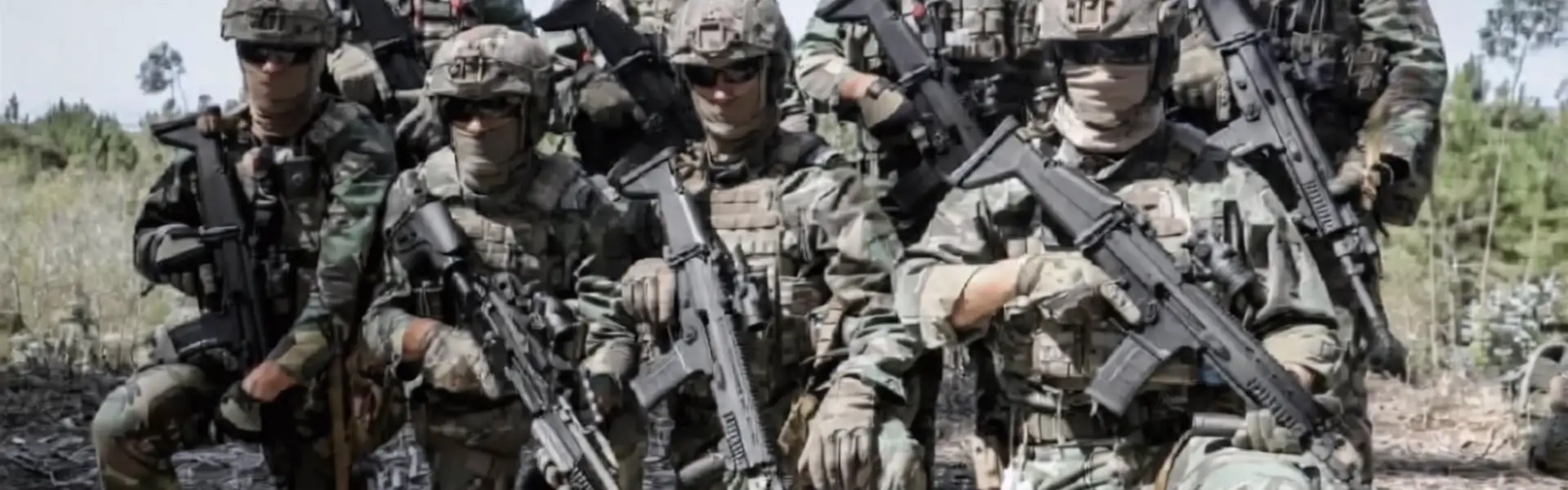
Portuguese Army Surplus
Comandos • Fuzileiros • Força Aérea • NATO Founding Member
Authentic gear from the Forças Armadas Portuguesas — Portugal's armed forces, a NATO founding member since 1949 and one of the oldest continuously-operating militaries in Europe. Three signature unit-identification t-shirts: the Comandos (Portuguese Army Commandos, the red-beret special- operations unit founded in 1962 during the Portuguese Colonial War), the Fuzileiros (the elite Portuguese Marine Corps — one of the oldest marine units in the world, dating to 1618), and the Força Aérea (Portuguese Air Force) blue service shirt. For collectors of Iberian and Atlantic- NATO militaria, Portuguese gear sits alongside the Spanish, French, and Italian surplus catalogs as core European-NATO heritage.
About Portuguese Army Surplus at Keep Shooting
Portugal occupies a distinctive position in European military history — a NATO founding member since April 4, 1949, home to one of the oldest active armed forces in continuous operation in Europe (the Portuguese Crown's army traces its modern lineage to the 12th century), and a country whose 20th-century military experience — the 13-year Portuguese Colonial War in Africa, the 1974 Carnation Revolution that ended both the war and the Estado Novo dictatorship in a single day, and the subsequent transition to a modern Western European NATO ally — is unique in the alliance. Keep Shooting's Portuguese surplus catalog is small but identity-rich: three unit-specific t-shirts representing the Comandos, the Fuzileiros, and the Força Aérea Portuguesa.
The Comandos — Portugal's red-beret Army commandos. The Comandos (Portuguese Army Commandos) were established in 1962 during the early years of the Guerra Colonial (Portuguese Colonial War, 1961–1974) — the 13-year counter-insurgency campaign that Portugal fought simultaneously in three African theaters: Angola, Mozambique, and Guinea-Bissau, against locally-organized independence movements (MPLA, FRELIMO, and PAIGC respectively). The Comandos were created as a light-infantry rapid-deployment force specialized in jungle and bush counter-insurgency operations, modeled partly on the British Royal Marine Commandos and partly on early-1960s American Special Forces doctrine. Comandos wear a distinctive boina vermelha — red beret — as their unit identifier, and their motto is "Audaces fortuna juvat" ("Fortune favors the bold," from Virgil's Aeneid). The Comandos saw heavy combat in all three colonial theaters through 1974 and are widely regarded as one of the most capable counter-insurgency units that fought in Africa during that period. After the 1974 Carnation Revolution and the end of the colonial campaigns, the Comandos were reorganized as part of Portugal's modern peacetime army and continue to serve today as the Regimento de Comandos within the Brigada de Reação Rápida (Rapid Reaction Brigade).
The Fuzileiros — one of the oldest marine corps in the world. The Portuguese Corpo de Fuzileiros (Marine Corps) traces its institutional lineage to 1618 — when the Portuguese Crown established the original Terço da Armada da Coroa de Portugal ("Crown's Naval Tercio") as a dedicated seaborne infantry force. That makes the Fuzileiros, by lineage if not by continuous service, one of the oldest marine corps in the world — predating the British Royal Marines (1664), the United States Marine Corps (1775), and most other national marine forces. The original Tercio served through the Portuguese Restoration War (1640–1668) and across the Portuguese maritime empire for the next two centuries before being disbanded in 1890; the modern Fuzileiros were re-established in 1961 at the start of the Colonial War and have served continuously since. The modern Fuzileiros are organized as the Corpo de Fuzileiros within the Marinha Portuguesa (Portuguese Navy) and operate as elite light infantry, amphibious assault specialists, and naval-special- operations forces. Their motto is "Pela Pátria, pela Honra, pelo Mar" ("For the Homeland, for Honor, for the Sea"). The Fuzileiros are widely respected within NATO as the small-but- professional elite of the Portuguese military.
The Força Aérea Portuguesa. The Portuguese Air Force (FAP) was established in its modern form in 1952 as a separate service branch, having previously existed as Aeronáutica Militar (Army aviation) and Aviação Naval (Naval aviation) since the early 1910s. The FAP saw extensive service in the Colonial War through 1974 — flying Fiat G.91 ground-attack aircraft, North American T-6 Texans, and various transport and helicopter platforms in support of the African ground campaigns. Today the FAP operates F-16 Fighting Falcons (which Portugal will replace with F-35s through 2030+), C-130 Hercules transports, P-3 Orion maritime patrol aircraft, and a modern helicopter fleet. The FAP has a small but capable force structure — roughly 7,000 active personnel — and contributes regularly to NATO air-policing missions including Baltic Air Policing rotations. Lajes Field in the Azores — the joint US-Portuguese air base in the mid-Atlantic — is a strategically important NATO installation that the FAP shares with the US Air Force.
The Portuguese Colonial War — 1961 to 1974. The backdrop to most modern Portuguese military history is the Colonial War — a 13-year, three-theater counter-insurgency that mobilized a substantial portion of the Portuguese male population through compulsory military service and shaped the identity of the Comandos, Fuzileiros, and Air Force as combat-experienced professional units rather than peacetime garrison forces. The war began in Angola in March 1961 with the UPA uprising and expanded to Guinea-Bissau (1963) and Mozambique (1964); over 13 years approximately 1.4 million Portuguese personnel rotated through the African theaters, with roughly 8,000 Portuguese military deaths and substantially higher local casualties on all sides. The war ended on April 25, 1974, when a group of mid-rank Portuguese military officers (the Movimento das Forças Armadas — MFA) executed the Carnation Revolution, overthrowing the 48-year-old Estado Novo dictatorship in a near-bloodless coup and immediately ending the war. The revolution's name comes from the red carnations that civilians placed in the rifle barrels of soldiers during the day as a sign that the troops would not fire on the population — and a symbol the Portuguese military still commemorates. April 25 ("Dia da Liberdade" — "Freedom Day") remains Portugal's most important national holiday.
NATO founding member. Portugal was one of the twelve original NATO founding members who signed the North Atlantic Treaty in Washington, D.C. on April 4, 1949 — alongside the United States, the United Kingdom, France, Belgium, Netherlands, Luxembourg, Canada, Italy, Iceland, Norway, and Denmark. Portugal's NATO membership has been continuous since, even through the Estado Novo dictatorship era — the alliance accepted Portuguese membership on geographic and strategic grounds (Portugal's Atlantic position, the Azores air base, and Portuguese maritime infrastructure) despite the political character of the regime. After 1974, democratic Portugal deepened its NATO integration and joined the European Communities (now EU) in 1986. Modern Portugal is a fully-integrated NATO ally, contributing forces to Bosnia, Kosovo, Afghanistan (where the Portuguese Comandos and Fuzileiros served alongside US and other NATO special operations units), and ongoing Eastern European NATO deterrence operations.
Portuguese military firearms — a brief history. Portugal's small-arms history is worth knowing for the militaria context. The Mauser-Vergueiro 1904 — designed by Portuguese officer José Alberto Vergueiro and manufactured at Deutsche Waffen- und Munitionsfabriken in Germany on a Mauser action — was Portugal's first 20th-century service rifle. The Vergueiro served through World War I and into the 1940s before being replaced by standard Mauser-pattern rifles. Through the Colonial War the Portuguese infantry's primary service rifle was the Heckler & Koch G3, license-built in Portugal at FBP and INDEP factories as the m/961 and m/963 — the same G3 platform used by German, Norwegian, Pakistani, and many other allied forces. Modern Portuguese forces adopted the Heckler & Koch G36 in 2008 as the replacement for the G3, and current SOF units use the HK416 platform. For G3 / HK accessory shopping see our broader HK Parts and G3 Parts categories.
Atlantic and Mediterranean NATO surplus context. Portuguese surplus sits within the broader Iberian, Atlantic, and Mediterranean NATO surplus ecosystem. The Spanish Army Surplus catalog is the natural Iberian companion (Spain and Portugal share the Iberian Peninsula and a long, complicated military-political history); the Italian Army Surplus and French Army Surplus catalogs cover the Mediterranean and Western European NATO neighbors. For broader surplus shopping see our Military Surplus hub or the Military Surplus Shirts category where the Portuguese Comandos, Fuzileiros, and Força Aérea t-shirts live alongside the broader NATO unit-shirt catalog.
Keep Shooting ships all Portuguese Army surplus from our Pennsylvania warehouse with free shipping on orders over $49.95 and hassle-free returns. Whether you are a militaria collector documenting NATO unit identification, a Portuguese-American looking for unit-pride apparel from the home country's elite forces, a Colonial-War-history student building a representative collection, or simply a buyer who appreciates that "Fuzileiros" reads better than "Marines" on a t-shirt — every item in our Portuguese surplus catalog is genuine Portuguese-Forças-Armadas-issue production, not commercial reproduction.
Frequently Asked Questions — Portuguese Army Surplus
Keep Shooting carries a wide selection of Portuguese Army Surplus products from trusted brands. Browse our catalog to see the full range, and use the filters on the left to narrow by brand, price, or product type.
Yes! All orders over $49.95 qualify for free shipping, including Portuguese Army Surplus products. Orders typically ship within 1–2 business days.
Keep Shooting offers hassle-free returns on Portuguese Army Surplus products. If you're not completely satisfied, contact our customer service team for a return authorization. All products must be in original, unused condition.
If you need help choosing the right Portuguese Army Surplus product, our team is available to assist. Check individual product descriptions for detailed specifications, or contact us directly and we'll help you find the best fit for your needs.