
Personal Defense Handgun Ammo
Hydra-Shok • Critical Defense • XTP • DPX • +P Defensive JHP
Purpose-engineered Jacketed Hollow Point defensive ammunition from the four houses that built the modern American concealed-carry market — Federal Premium Hydra-Shok (the 1989 Tom Burczynski design adopted by the FBI after the 1986 Miami shootout), Hornady Critical Defense (the 2008 Flex Tip cartridge engineered for short-barrel concealed-carry pistols), Hornady Custom XTP (eXtreme Terminal Performance, the consistent-expansion-across-velocity bullet that has become the industry baseline), and Corbon (the South Dakota defense-ammunition specialist founded by Peter Pi Sr. in 1985, including the DPX Barnes solid-copper collaboration). Calibers cover .45 ACP +P, .40 S&W, .357 Magnum, .380 ACP, .32 ACP, and .38 Super +P. Carry the round you trust — and train with the same box you carry.
About Personal Defense Handgun Ammo at Keep Shooting
Keep Shooting's Personal Defense Handgun Ammo catalog is the curated selection of purpose-engineered defensive cartridges across the most common concealed-carry calibers — .45 ACP and .45 ACP +P, .40 S&W, .357 Magnum, .380 ACP, .32 ACP, and .38 Super +P. Every cartridge here is a premium-tier defensive load from one of the four houses that built the modern American defensive ammunition market: Federal Premium (Hydra-Shok), Hornady (Critical Defense and Custom XTP), Corbon (Personal Defense and DPX), and PMC (JHP and Bronze +P). For high-volume range practice see our value-tier Target Shooting Handgun Ammo; for suppressor use see our Suppressor-Ready Handgun Ammo selection.
Why JHP for defense. Jacketed Hollow Point bullets are the defensive standard for two reasons. First, controlled expansion: a hollow cavity in the bullet nose causes the bullet to mushroom outward on impact with soft tissue, roughly doubling the wound channel diameter (a typical .45 ACP JHP expands from .451 inches at the muzzle to .70 to .85 inches in ballistic gelatin), transferring substantially more energy to the target and producing the terminal effect that defensive shooters depend on. Second, reduced over-penetration: where a full-metal-jacket bullet typically passes through a human-sized target with most of its energy retained (presenting a serious risk to anyone behind the target), a well-engineered JHP transfers most of its energy in the first 12 to 16 inches of penetration — the FBI defensive-ammunition penetration standard adopted after the 1986 Miami shootout. JHP is the dominant choice for concealed carry, home-defense, and law-enforcement duty ammunition for these reasons.
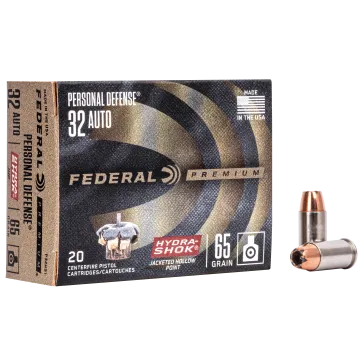
Federal Premium Hydra-Shok — the FBI standard. The Federal Hydra-Shok was designed by Tom Burczynski in the late 1980s and adopted by the FBI in 1989 as the bureau's official duty cartridge — the federal government's first purpose-engineered defensive ammunition contract following the 1986 Miami shootout that exposed the limitations of the then- standard 9mm 115-grain JHP. The Hydra-Shok's distinctive feature is a center post inside the hollow cavity, designed to ensure consistent expansion whether the bullet passes through clothing, glass, plywood, or sheet steel before reaching its target — the heavy-clothing scenarios that had defeated earlier hollow-point designs. The Hydra-Shok served as the FBI's primary issue duty round through the 1990s and remains one of the most-tested commercial defensive cartridges in American history. Our catalog stocks the Federal Premium Hydra-Shok 45 ACP ($35.83) — the flagship Hydra-Shok loading in the original 1905 .45 ACP cartridge — and the unusual Federal Premium Hydra-Shok 32 ACP Personal Defense ($32.20) for owners of small-caliber European pocket pistols (Walther PPK, CZ 70, Beretta 81) who want a defensive- grade cartridge instead of standard FMJ.
Hornady Critical Defense — the short-barrel cartridge. The Hornady Critical Defense line was introduced in 2008 to solve a specific problem with traditional JHP designs: in short-barrel concealed-carry pistols (typically 2 to 3.5 inch barrels) bullet velocity drops substantially below the engineering threshold most JHPs were optimized for, and clothing plugging the hollow cavity prevented reliable expansion. The Critical Defense bullet uses a proprietary FTX Flex-Tip design — a soft polymer insert in the bullet cavity that prevents clothing plugging and initiates expansion at lower velocities than standard JHP designs. This makes Critical Defense one of the few cartridges specifically validated for short-barrel concealed-carry platforms (Glock 43, Sig P365, Ruger LCP MAX, S&W Bodyguard, etc.). Our Hornady Critical Defense 357 Magnum ($39.30) is the snub-nose-revolver loading — engineered for the Smith & Wesson Model 60, Ruger SP101, Charter Arms Bulldog, and similar 2-inch-barrel snub-nose revolvers where standard 357 Magnum loads exhibit poor expansion at the reduced velocity.
Hornady Custom XTP — consistent expansion across velocity. The XTP (eXtreme Terminal Performance) bullet was Hornady's earlier defensive bullet design (predating Critical Defense by roughly two decades, with production beginning in the late 1980s). The XTP uses a traditional jacketed-hollow-point design with engineered serrations in the bullet jacket that initiate controlled expansion across the full velocity range a typical defensive load might encounter (from short-barrel low-velocity encounters at one end to magnum full-power loads at the other). XTP has become the industry baseline for traditional JHP defensive design and is widely loaded by other ammunition manufacturers (Black Hills, Federal, Sig Sauer Elite Defense, Remington Golden Saber, etc.) as the bullet component in their own defensive loadings. Our Hornady Custom 45 ACP +P 230-grain XTP Hollow Point ($31.02) is the +P variant of the traditional 230-grain .45 ACP ball, retuned with a stout XTP bullet for serious defensive use in 1911 and modern .45 ACP platforms.
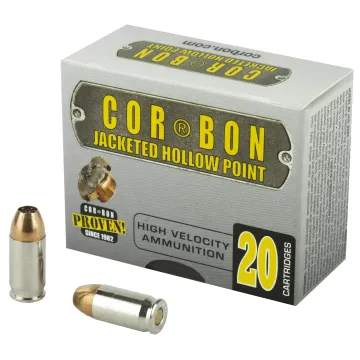
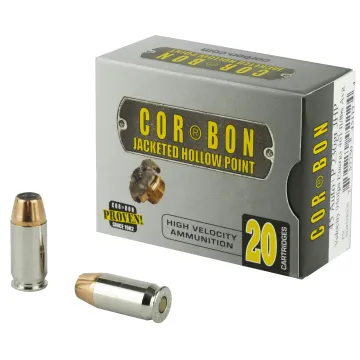
Corbon — the South Dakota defensive specialist. Corbon Ammunition (corBon Bullet Company) was founded in 1985 by Peter Pi Sr. in Sturgis, South Dakota, and has been one of the more focused defensive-ammunition specialists in the American market for four decades. Where Federal and Hornady are diversified ammunition houses producing defensive ammunition alongside broader hunting and target lines, Corbon's identity has always been the defense and law-enforcement market specifically. The Corbon Personal Defense line uses traditional jacketed hollow points loaded to higher- than-SAAMI velocities (Corbon's signature is loading at the top end of the SAAMI pressure envelope, sometimes pressing against +P ratings) for maximum terminal performance. Our catalog stocks Corbon Personal Defense 380 ACP ($20.76), Corbon Personal Defense 45 ACP +P JHP ($29.23), and the more specialized Corbon DPX below.
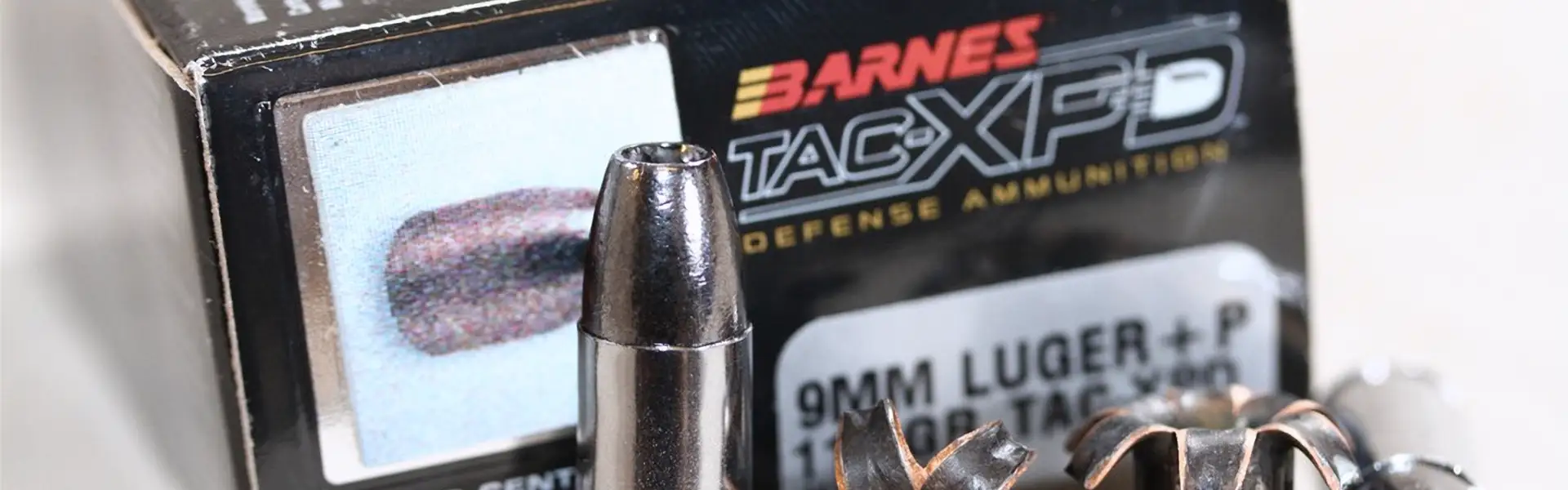
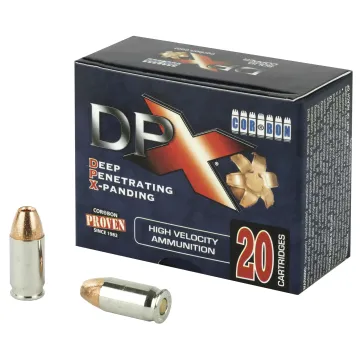
Corbon DPX — the Barnes solid-copper collaboration. The Corbon DPX (Deep Penetrating eXtreme) line was developed in collaboration with Barnes Bullets and uses a Barnes solid-copper hollow-point bullet rather than the traditional lead-core jacketed design. The all-copper construction means the bullet expands without fragmenting (lead-core JHPs can shed jacket material during expansion, reducing penetration depth and the bullet's effective weight on target), which results in deeper penetration and more consistent expansion across clothing and barrier obstacles. Solid-copper bullets are also lead-free, which matters for shooters in California (where lead-core ammunition is restricted for certain hunting applications) and for indoor-range shooters sensitive to airborne lead exposure. Our Corbon DPX 380 ACP Personal Defense ($26.55) is the pocket-pistol DPX offering — engineered for the Ruger LCP, Sig P365 .380, S&W Bodyguard, and similar small pocket guns where the Barnes all-copper construction's deep-penetration characteristics compensate for the inherently modest .380 cartridge.
+P loads — what they are and what platforms can run them. The +P designation (sometimes written "+P" or "Plus-P") means a cartridge has been loaded to chamber pressures above the standard SAAMI maximum for that caliber but within an established +P pressure ceiling (typically 10 to 20 percent above standard). Common +P calibers include .38 Special, .380 ACP, 9mm Luger, .45 ACP, and .38 Super (which is always +P — the "Super" designation distinguishes it from the older standard-pressure .38 ACP). +P ammunition produces higher velocity, higher recoil, and accelerated wear on the firearm — and not all firearms are rated for +P use. Older revolvers, some smaller concealed-carry pistols, and firearms not specifically marked as +P-rated should not be fed +P ammunition routinely. Check your firearm's manual or the manufacturer's specifications before running +P loads. Modern Glock, Sig Sauer, S&W M&P, Beretta, and most commercially-marketed full-size pistols are +P-rated; older revolvers and budget pistols may not be. Our +P offerings include Corbon 45 ACP +P JHP, Hornady Custom 45 ACP +P XTP, and the always-+P PMC Bronze 38 Super +P.
.357 Magnum — the revolver defense cartridge. The .357 Magnum was introduced in 1934 by Smith & Wesson and Winchester as the first true magnum revolver cartridge — a longer-cased, higher-pressure development of the .38 Special that the bureau and major American police departments adopted as the dominant duty cartridge through the 1980s. The FBI carried .357 Magnum revolvers as primary issue from 1935 through the late 1980s, and most American municipal police departments followed similar timelines. Modern .357 Magnum survives primarily as a concealed- carry revolver cartridge in snub-nose six-shot revolvers (Smith & Wesson Model 60, Ruger SP101, Charter Arms Bulldog) where the cartridge's defensive performance compensates for the small platform's capacity limit. Our Hornady Critical Defense 357 Magnum ($39.30) is the snub-nose-optimized FTX Flex-Tip loading. Note: .357 Magnum revolvers can also fire the shorter .38 Special cartridge (which produces less recoil and is suitable for practice and less-experienced shooters), but not vice versa.
.380 ACP for pocket carry. The .380 ACP (developed by John Browning in 1908) is the dominant cartridge for the pocket-pistol category that has come to define modern American everyday-carry. The Ruger LCP family, Sig P365 .380, S&W Bodyguard, and Glock 42 have made the cartridge the standard answer for shooters who want a concealed firearm small enough to carry in a front pocket holster or an ankle holster. The trade-off is terminal performance — .380 ACP produces less energy than 9mm Luger and substantially less than .45 ACP, so defensive .380 ammunition selection matters more than for larger calibers. Our three .380 defensive loads are the Corbon DPX 380 ($26.55, Barnes all-copper), Corbon Personal Defense 380 ($20.76, traditional JHP), and the cross-listed PMC Bronze 380 ($23.71) for FMJ practice.
.40 S&W — the FBI cartridge that came and went. The .40 S&W was developed in 1990 by Smith & Wesson and Winchester following the FBI's post-1986 Miami shootout re-evaluation. The Bureau wanted a round more powerful than 9mm but with less recoil than the 10mm they had briefly adopted; .40 S&W was the answer, and it dominated American law enforcement through the 1990s and 2000s. In 2016 the FBI publicly returned to 9mm citing improved 9mm bullet technology, and most American police departments followed. The .40 remains in active use but is no longer the default service caliber. Our PMC 40 S&W 165-grain JHP ($32.18) is the defensive-grade JHP loading — distinct from the FMJ training ammunition in the target category.
The carry-and-train rule. The single most important practical recommendation for defensive ammunition is to train with the same load you carry — at least one cylinder or one magazine per range session. Defense ammunition is more expensive than training FMJ, so most shooters train primarily on FMJ and shoot a small quantity of their carry load to verify reliable feeding and point-of-impact. Reliable feeding is the critical test: defensive JHP profiles vary, and a load that runs flawlessly in one pistol may exhibit failure-to- feed in another. Verify the carry load runs reliably through your specific pistol — at minimum 200 rounds across multiple range sessions before trusting the load for daily carry. Point-of-impact also varies between training FMJ and defensive JHP loads (different bullet weights and velocities), so a defensive load that prints 2 inches off your training load at 25 yards is normal — verify the actual point-of-impact and adjust holdover accordingly.
Companion ammunition categories. For range practice with the same calibers see our Target Shooting Handgun Ammo; for suppressor pairing see Suppressor-Ready Handgun Ammo; for hunting applications see Handgun Hunting Ammo. The consolidated 9mm landing page is at 9mm top-caliber. For the platforms these cartridges feed see our Pistols catalog and matching concealed-carry holsters.
Keep Shooting ships all defensive ammunition from our Pennsylvania warehouse with free shipping on orders over $49.95 and hassle-free returns. Whether you carry a Glock 19 or Sig P320 with Hydra-Shok or Critical Defense, a Smith & Wesson Model 60 snub-nose with Critical Defense .357 Magnum, a 1911 with Hornady XTP +P or Corbon +P JHP, a Ruger LCP or Sig P365 .380 with Corbon DPX or Corbon Personal Defense, or a Walther PPK in .32 ACP with Federal Premium Hydra-Shok — every defensive cartridge in this catalog is from a respected American manufacturer with a track record validated by decades of FBI, law-enforcement, and civilian-carry use. Carry the round you trust, train with the same load, and verify reliable function in your specific pistol before betting on it for daily carry.
Frequently Asked Questions — Personal Defense Handgun Ammo
Keep Shooting carries a wide selection of Personal Defense Handgun Ammo products from trusted brands. Browse our catalog to see the full range, and use the filters on the left to narrow by brand, price, or product type.
Yes! All orders over $49.95 qualify for free shipping, including Personal Defense Handgun Ammo products. Orders typically ship within 1–2 business days.
Keep Shooting offers hassle-free returns on Personal Defense Handgun Ammo products. If you're not completely satisfied, contact our customer service team for a return authorization. All products must be in original, unused condition.
If you need help choosing the right Personal Defense Handgun Ammo product, our team is available to assist. Check individual product descriptions for detailed specifications, or contact us directly and we'll help you find the best fit for your needs.