
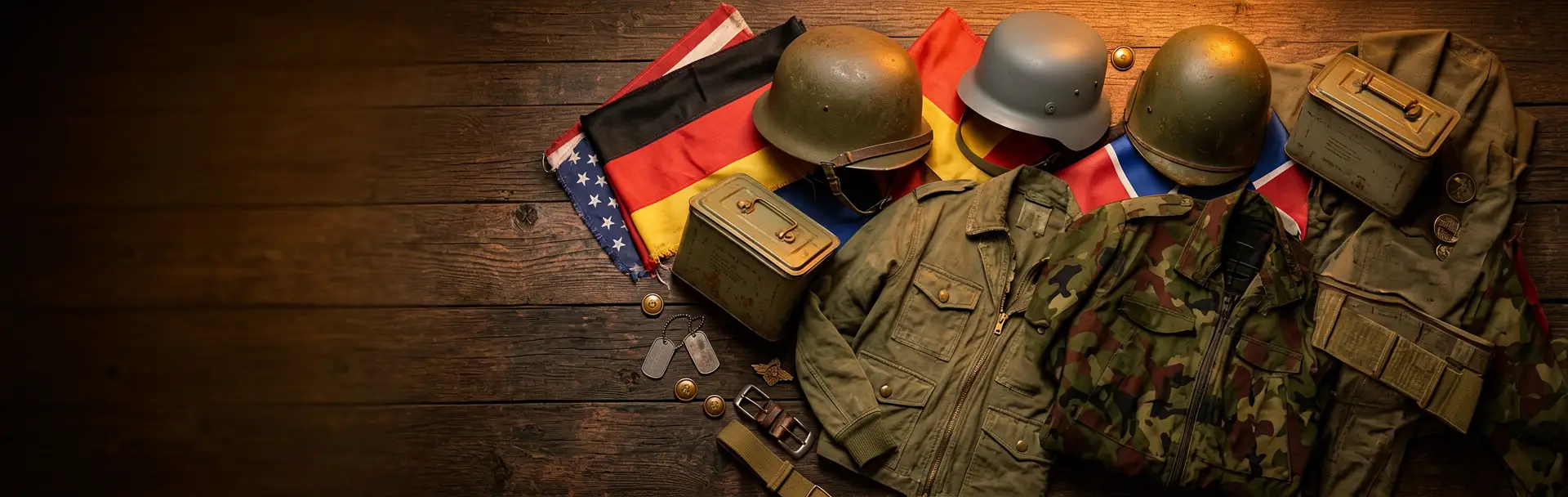
29 Nations • Cold War Through Modern NATO • Authentic Surplus
Military Surplus by Country
The deepest country-organized military surplus catalog on the US market — 29 national militaries spanning Western European NATO founding members, Cold War Warsaw Pact production, Nordic cold-weather doctrine, Alpine armed neutrality, modern Middle Eastern forces, African post-colonial militaries, and the full US military equipment ecosystem. From the Russian Mosin-Nagant to the Swiss K31, the Spanish CETME to the Polish PM-63 RAK, the Romanian Cugir AK to the Norwegian Heimevernet — every item authentic surplus, never commercial reproduction.
Region
Western European NATO
Founding NATO members and the Western European core — the alliance's original Atlantic-and-Mediterranean bloc, with deep equipment heritage spanning the H&K G3 / CETME lineage, Belgian FN production, French Foreign Legion history, and modern Eurofighter-tier forces.

Belgium
FN Herstal • Para-Commando

Britain
DPM Camo • Royal Marines • SA80

Netherlands
KMar • Mariniers

France
Foreign Legion • CCE Camo • FAMAS

Germany
Bundeswehr • Flecktarn • HK G3

Greece
Hellenic Army • Mediterranean NATO

Italy
Alpini • Telo Mimetico • Beretta

Portugal
Comandos • Fuzileiros • Força Aérea

Spain
La Legión • Guardia Civil • CETME
Region
Nordic
NATO's northern flank and the alliance's cold-weather authorities — Norway hosts the NATO Centre of Excellence for Cold Weather Operations; Sweden ended 210 years of armed neutrality with NATO accession in 2024; Finland joined in 2023 after Russia's Ukraine invasion.


Region
Alpine
Mountain-warfare specialists and Switzerland's continuing armed neutrality — recognized in 1815, the world's longest unbroken non-alignment. Both militaries field domestic-designed small arms (Swiss K31 / Stgw 57, Austrian StG 77) and maintain elite Alpine combat doctrine.


Region
Warsaw Pact / Eastern Bloc Legacy
The Soviet-design military ecosystem — Warsaw Pact members 1955–1991 plus Yugoslav-successor states. Most adopted Soviet small-arms patterns (Mosin-Nagant, then AKM, then AK-74) and produced their own variants under license. Most are now NATO members.

Bosnia
Bosnian War Era • Yugoslav Heritage

Bulgaria
Arsenal AKKM • Cold War

Croatia
Croatian Defense • Yugoslav Heritage

Czech Republic
vz. 58 • CSLA Cold War

East Germany
NVA • Strichtarn • MPi-K

Hungary
AMD-65 • Honvédség

Poland
Pantera • PPS-43 • PM-63 RAK

Romania
M94 Camo • M73 Helmet • Cugir AK

Russia
Mosin-Nagant • PPSh-41 • GP-5

Serbia
Yugoslav Heritage • Zastava M70
Region
Middle East
The Israel Defense Forces (Tzahal) — founded May 1948, built the Uzi (1950s) and Galil (1972), and produced the post-1967-war doctrine that influenced every modern small-state military with a population-disadvantaged defensive posture.

Region
Africa
Post-colonial African militaries with gear acquired from the global military-aid network — French, Soviet, Chinese, and US-pattern equipment in many countries' inventories. Authentic African surplus is rare and highly collectible.


Region
Asia
The People's Liberation Army — the world's largest active military by personnel, with the Type 56 (Norinco-licensed AK-47) and the iconic Type 56 chest bandolier as the most recognizable Cold-War PLA items in the global surplus market.

Region
North America
The largest military surplus catalog in the world — six service branches, OCP Multicam current standard, the full MOLLE II load-bearing ecosystem, and equipment supplied to the commercial market through DLA disposal and DRMO channels since 1865.

About Military Surplus by Country
Authentic military surplus is fundamentally different from commercial reproduction gear. Surplus items are produced under government contract to military specifications, used in service (or stockpiled for service), and released to the civilian market through formal disposal channels — DLA Disposition Services in the US, NATO national disposal-service equivalents, and post-Cold-War demobilization sales from former Warsaw Pact armories. The result is gear with materials, construction, and durability that commercial outdoor and tactical-clothing manufacturers cannot economically replicate at consumer-tier pricing.
Why country-specific surplus matters. Military equipment is engineered for the specific operational environment of the issuing military. Norwegian wool socks are designed for Arctic operations at -30°C; Italian Telo Mimetico camouflage is engineered for Mediterranean scrub-and-rock terrain; Russian GP-5 gas masks were produced for tactical-nuclear-environment doctrine; Swiss field gear assumes 70% mountainous terrain. Buying country-specific surplus means acquiring gear that was tested against an actual operational standard rather than a marketing target — and those operational standards translate directly to civilian use cases for hikers, hunters, EMS professionals, cold-weather workers, and collectors.
The Cold War — NATO and Warsaw Pact production. The bulk of post-WWII military surplus comes from the 1949–1991 Cold War — the period when both NATO and the Warsaw Pact maintained full-mobilization stockpiles against the possibility of major European conventional war that never came. NATO members standardized on US-pattern equipment (with national adaptations — German Flecktarn, British DPM, Italian Telo Mimetico, Norwegian M/75) and shared key calibers (.30-06, 7.62×51 NATO, 5.56×45 NATO). Warsaw Pact members standardized on Soviet-pattern equipment (national-license AKM rifles from Cugir / Radom / Zastava / VEB Suhl, common 7.62×39 and 5.45×39 cartridges) with national variations in camouflage and field gear. The 1991 Soviet collapse and Warsaw Pact dissolution released enormous stockpiles to the civilian surplus market — the source of most Czech vz. 58, East German MPi-K, Polish PM-63, and Romanian Cugir AK accessories available today.
Post-Cold-War transitions and modern NATO. The countries that joined NATO between 1999 and 2024 — Poland, Hungary, and the Czech Republic in 1999; the Baltic states, Romania, Bulgaria, Slovakia, and Slovenia in 2004; Albania and Croatia in 2009; Montenegro and North Macedonia after; Finland in 2023; Sweden in 2024 — represent a historic Westernization of European military doctrine and equipment. Their surplus catalogs uniquely span both eras: Cold-War Eastern-Bloc gear from before accession, and post-accession NATO-standard equipment as Westernization proceeded. This transitional surplus is among the most interesting militaria from the last 35 years.
The Nordic cold-weather tradition. Norway, Sweden, and Finland share a wool-and-cold-weather tradition that is unmatched in the rest of the global military surplus ecosystem. Norway's Heimevernet Home Guard traces directly to the WWII Milorg resistance and equips 45,000 territorial defenders; Sweden's M90 Splittermönster camouflage and F1 pilot survival knife are gold-standard Nordic field-gear items; Finland's sissi-pattern light-infantry doctrine produced gear engineered for Karelian forest combat against an order-of-magnitude-larger Soviet adversary. Norwegian Fjellduken sleeping covers, Swedish wool blankets, and Finnish Sissipuukko knives are widely sought by serious cold-weather outdoor users.
Iberian and Mediterranean depth. Spain operates one of the most institutionally diverse uniformed-service ecosystems in Europe — eight distinct uniformed institutions (Army, Navy, Air Force, La Legión Foreign Legion, Guardia Civil gendarmerie, Policía Nacional, Cruz Roja, Correos postal service) — and the Spanish CETME rifle was the design ancestor of the H&K G3 that became the dominant Western 7.62×51 NATO battle rifle. Portugal's Comandos and Fuzileiros (one of the world's oldest marine corps, dating to 1618) define modern Portuguese military identity. Italian Alpini mountain troops and Carabinieri gendarmerie complete the Mediterranean-NATO cluster.
Specialty militaries — Switzerland, Israel, the United States. Switzerland's 210-year armed neutrality (recognized 1815, unbroken since) produced an unusually self-sufficient domestic military-industrial base — the K31 Karabiner is widely regarded as the finest mass-produced military bolt-action rifle ever made; Swiss bunker candles support the per-capita largest civil-defense bunker network on Earth. Israel's Tzahal (founded May 1948) operates one of the most combat-experienced militaries in the world; the Galil rifle (1972) and Uzi submachine gun (1950s) are global icons of small-state indigenous arms development. The United States operates the world's largest military and the corresponding world's largest military surplus catalog — 300+ SKUs in our store alone covering OCP Multicam, ACU UCP, BDU Woodland, MOLLE II, USMC SFLCS, USAF ABU Tiger Stripe, and the broader US-issue gear ecosystem.
Authenticity and sourcing. Every item in our country-specific catalogs is authentic surplus sourced through authorized importers, government- disposal contracts, and international militaria wholesalers with documented chain-of-custody. Where items are commercial-production licensed equivalents (rather than original issue-stock), this is noted on the relevant product page. Period-correct authenticity is critical for collectors, reenactors, and militaria historians; functional military-grade quality is what outdoor users, EMS professionals, and cold-weather workers value. Both buyer profiles are well-served by genuine surplus.
Buyer use cases. Country-specific surplus serves distinct buyer markets: Cold-War militaria collectors building documentation-quality displays of period equipment; military reenactors and living-history groups who need period-correct uniforms for specific impressions (Wehrmacht, Red Army, NVA, USMC Pacific, etc.); backcountry hikers and hunters who appreciate military-grade wool, leather, and waterproof construction at below-commercial pricing; EMS and trail-medic professionals who value the often-superior medical kit quality from European militaries; cold-weather outdoor workers who appreciate the Nordic and Russian wool-and- cold-weather gear traditions; and airsoft and force-on-force training organizers who need period-correct or platform- specific kit for scenario authenticity.
Companion catalogs. For shopping by gear category rather than national origin see our master Military Surplus hub or the specialized sub-categories: Jackets, Pants, Shirts, Footwear, Helmets, Bags & Packs, Gas Masks, and Patches & Insignia.
Alphabetical Reference
Direct A-Z links to all 29 country surplus catalogs.
Looking for something specific?
Browse the full military-surplus catalog by gear category, or contact us with a specific country / unit request.