
Machetes
Military Issue • Bolo • Kukri • Bush • 13 Models
The machete is the most universally deployed edged field tool in military history — US M1942 jungle pattern, Australian Army sawback, French Army Wildsteer, Philippine bolo, Nepali kukri, African panga, Caribbean cane cutter. Keep Shooting carries 13 machetes ranging from the $11.95 Bush Pro entry through the $185 Woodman's Pal Classic American heirloom, covering Ka-Bar Cutlass, Ontario Knife Heavy Duty and Field, SOG Sogfari, Cold Steel Bolo and Kukri, plus US, Australian, and French military-issue patterns.
About Machetes at Keep Shooting
Keep Shooting carries a 13-machete selection covering the full span of military-issue, brand-tactical, and heirloom-grade field blades. Our catalog includes US Military sawback and standard patterns, the Australian Army machete with sheath, the French Army Wildsteer Wild Tiger, Ontario Knife Heavy Duty and Field machetes (OKC is the longest-running US military machete OEM), Ka-Bar Cutlass, SOG Sogfari, Cold Steel Bolo and Kukri, the Woodman's Pal Classic American brush tool, and the $11.95 Bush Pro entry. Whether you need a jungle-clearing pattern, a trail-maintenance brush tool, a tactical cutlass, or an accurate period reproduction for a WWII or Vietnam-era loadout, our machete catalog is the 100-year lineage of the world's most universally deployed edged field tool.
The word machete is the Spanish diminutive of macho — roughly "little sledgehammer" — derived from the Latin marcus, meaning a hammer or mallet. The tool itself predates the name by thousands of years; pre-Columbian agricultural civilizations across Mesoamerica, the Caribbean, and tropical South America used long-bladed chopping tools made from obsidian, flint, and later iron to clear forest, harvest cane, and process the dense fibrous vegetation that dominates tropical agriculture. The Spanish colonial expansion through the Americas, Philippines, and equatorial Africa spread steel-bladed machetes as the standard-issue agricultural implement everywhere sugar, cacao, bananas, rubber, and tropical hardwoods were produced — which, by the late 19th century, meant effectively the entire equatorial and tropical belt of the globe. The machete is today one of the most numerous bladed tools in human existence; the World Health Organization estimates that several hundred million working machetes are in daily agricultural use across tropical regions worldwide.
The modern American military machete lineage begins with Collins & Company of Collinsville, Connecticut, founded in 1826 by Samuel W. Collins originally to manufacture axes. Collins introduced its first machete pattern in 1845 and by the late 1800s had become so dominant in the Latin American machete trade that the generic term un Collin came to mean any machete at all in the agricultural vocabulary of Mexico, Central America, and the Caribbean. The US military's interest in the machete as a purpose-built combat and engineering tool (as opposed to a commandeered agricultural implement) dates to the Spanish-American War and Philippine Insurrection of 1898-1902, when American forces encountered the Filipino bolo — a heavy, forward-weighted short sword used both as an agricultural tool and a formidable close-combat weapon. Impressed by the bolo's effectiveness, the US Army adopted three model bolo machetes in 1904, and Collins was contracted to produce the Collins No. 1005 Engineer's Bolo — the first purpose-built US military machete pattern, carried by engineer units through WWI. The M1910 Bolo was classified as "armament" (not merely tool issue) by War Department Circular No. 210 on November 29, 1922.
The high-water mark of US military machete procurement was World War II. The Pacific theater's jungle combat environments — New Guinea, the Solomon Islands, Guadalcanal, the Philippines, Bougainville, Burma — made the machete a mission-essential piece of individual kit for Marine Raiders, Army jungle infantry, Navy corpsmen, and OSS detachments operating in dense tropical vegetation. The Navy and Marine Corps adopted the M1942 jungle machete, an 18-inch Collins-pattern blade with a distinctive leather-washer stacked handle, as the standard Pacific- theater issue. Over one million US military machetes were procured during WWII from Collins, Ontario Knife, True Temper, Village Blacksmith, and several other suppliers — the machete was one of the most widely-issued individual bladed tools of the war. The pattern continued in service through Korea and Vietnam; the American machetes that came home from Vietnam War infantry kits are direct lineage of the M1942 Collins pattern.
Ontario Knife Company — OKC — is the living link to this century-long US military machete lineage. Ontario began machete production for the US military during WWII and has been a continuous US Department of Defense machete supplier for eighty-plus years, producing the general-issue USMC and Army machetes that replaced the original Collins contracts. Our catalog carries two Ontario machetes: the Ontario Knife Heavy Duty Machete ($54.68) and the Ontario Knife Field Machete ($48.99), plus the LC18 US Military Machete ($52.20) which is the current-production Ontario-made US military-issue pattern. For the full Ontario catalog across knives, machetes, and tool patterns, see our Ontario Knife Company brand page.
Regional blade styles define the machete catalog beyond the US military pattern. The bolo — the Filipino forward-weighted heavy-belly blade — is represented by the Cold Steel Bolo Machete ($23.85), the most affordable entry in the category and an excellent choice for heavy chopping work where blade weight forward of the handle does the cutting. The kukri — the Nepali inward- curved Gurkha blade, adopted by the British Army's Brigade of Gurkhas and retained in Nepalese military service for more than two centuries — is represented by the Cold Steel Kukri Machete ($31.83), a purpose-built modern reproduction of the kukri profile without the ceremonial-grade price of a true Nepali-forged blade. The cutlass — the straight-blade short-sword pattern historically associated with naval boarding parties — is represented by the Ka-Bar Cutlass Machete ($76.72), a tactical-market reinterpretation of the pattern with a modern Kraton handle and a 11-inch 1085 carbon-steel blade. For the full Ka-Bar catalog including the USMC-issue USMC Mk 2 fighting/utility knife and the BK&T Becker line, see our Ka-Bar brand page.
The SOG Sogfari Machete (starting at $28.94) is SOG's budget-friendly lineup designed around a high-visibility orange-and-black Kraton handle and a hard-plastic sheath with belt-carry — the correct machete for trail clearing, hunting- camp brush work, and any environment where dropping the tool into underbrush means you're going to need to find it again. The Sogfari's handle geometry is a meaningful improvement over military-surplus wood-grip patterns for extended chopping sessions. For the full SOG catalog — founded in 1986 by Spencer Frazer as a tribute to the Vietnam- War MACV-SOG studies and observations group — see our SOG brand page.
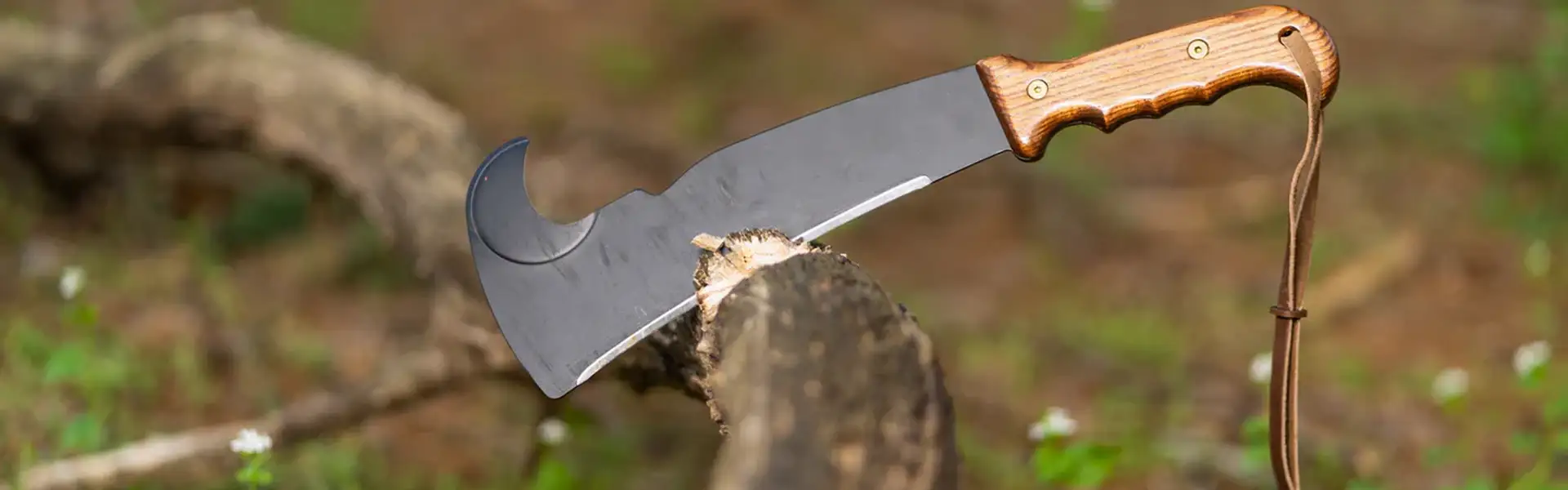
At the premium end of the catalog the Woodman's Pal Classic Machete ($185) is the American heirloom entry — a design that dates to 1941, manufactured continuously by Pro Tool Industries in Pennsylvania, and issued to the US Army during WWII as an engineer's brush tool for clearing fields of fire and constructing fortifications. The Woodman's Pal is a hybrid machete-hatchet with a sickle-curved main edge and a squared chopping toe; it's the specific tool you want for trail maintenance, shelter construction, and the hundred-year category of American forestry-and-brush work that the urban tactical market occasionally forgets is what the machete is actually for. The French Army Machete — Wildsteer Wild Tiger ($163.99) is the contemporary French military-issue blade, manufactured by Wildsteer in Thiers (the French cutlery capital since the 14th century) and fielded by French Foreign Legion and Army deployments to French Guiana, Djibouti, and sub-Saharan Africa. Both blades are high-investment pieces intended for decades of service.
For the military-surplus buyer, the US Military Sawback Machete ($48.84), US Military Machete ($42.49), and Australian Army Machete with Sheath ($88.73) are genuine-issue patterns — the sawback US machete is the Vietnam-era 18-inch blade with saw-tooth dorsal spine for cutting green bamboo and small-diameter wood, the standard US Military Machete is the baseline Collins-descended 18-inch pattern, and the Australian Army machete is the current Australian Defence Force issue from jungle deployments to East Timor, the Solomon Islands, and Papua New Guinea. The Bush Pro Steel Machete with Sheath ($11.95) is our entry-level option — not a museum piece but a working tool for yard brush, garden cleanup, and bug-out bag inclusion where the cost ceiling matters more than blade pedigree.
Choosing the right machete comes down to intended use. For jungle or heavy brush clearing, longer blades (18+ inches) and forward-weighted profiles (bolo, panga) deliver more chopping energy per swing — look at the US Military patterns, the French Wildsteer, or the Cold Steel Bolo. For trail maintenance and light brush work, shorter blades with balanced profiles — Ontario Heavy Duty, SOG Sogfari, or the Woodman's Pal — offer better control and reduce fatigue on extended work sessions. For tactical or survival applications, the Ka-Bar Cutlass or Cold Steel Kukri offer patterns designed around defensive as well as utility cutting. For period-correct historical reenactment, the US Military Sawback (Vietnam), standard US Military (WWII through Korea), and Australian Army (modern) are direct-issue correct patterns.
The machete lives in our broader Knives & Tools category, which also includes our Fixed Blade Knives catalog (the correct category for a belt-carry survival or fighting knife, which a machete is not), our Axes & Tomahawks category (the correct tool for heavy wood-splitting or breaching work), and Multitools for the urban-carry pocket-tool side of the catalog. Most serious outdoor kits include a machete alongside a fixed-blade knife and either an axe or a folding saw — the machete handles brush and vegetation, the fixed blade handles precision work and food prep, and the axe or saw handles wood over two inches in diameter.
Keep Shooting ships all machetes from our Pennsylvania warehouse with free shipping on orders over $49.95 and hassle-free returns. Some machetes are age-restricted at checkout per common carrier policies; we ship to all US states where bladed-tool mail order is legal. Whether you're stocking a jungle or tropical-deployment kit, building a WWII- through-Vietnam historical loadout, outfitting a bug-out bag or homestead tool set, or just replacing the $200 hardware- store machete you broke last season with a military-grade Ontario Knife or Ka-Bar, every machete in our catalog is authentic brand inventory from the manufacturers and military sources that have been equipping field professionals for a century.
Frequently Asked Questions — Machetes
Keep Shooting carries a wide selection of Machetes products from trusted brands. Browse our catalog to see the full range, and use the filters on the left to narrow by brand, price, or product type.
Yes! All orders over $49.95 qualify for free shipping, including Machetes products. Orders typically ship within 1–2 business days.
Keep Shooting offers hassle-free returns on Machetes products. If you're not completely satisfied, contact our customer service team for a return authorization. All products must be in original, unused condition.
If you need help choosing the right Machetes product, our team is available to assist. Check individual product descriptions for detailed specifications, or contact us directly and we'll help you find the best fit for your needs.