
Rimfire Ammo
CCI Mini-Mag • .22 LR • .22 WMR • Subsonic • Quiet-22 • Tracer
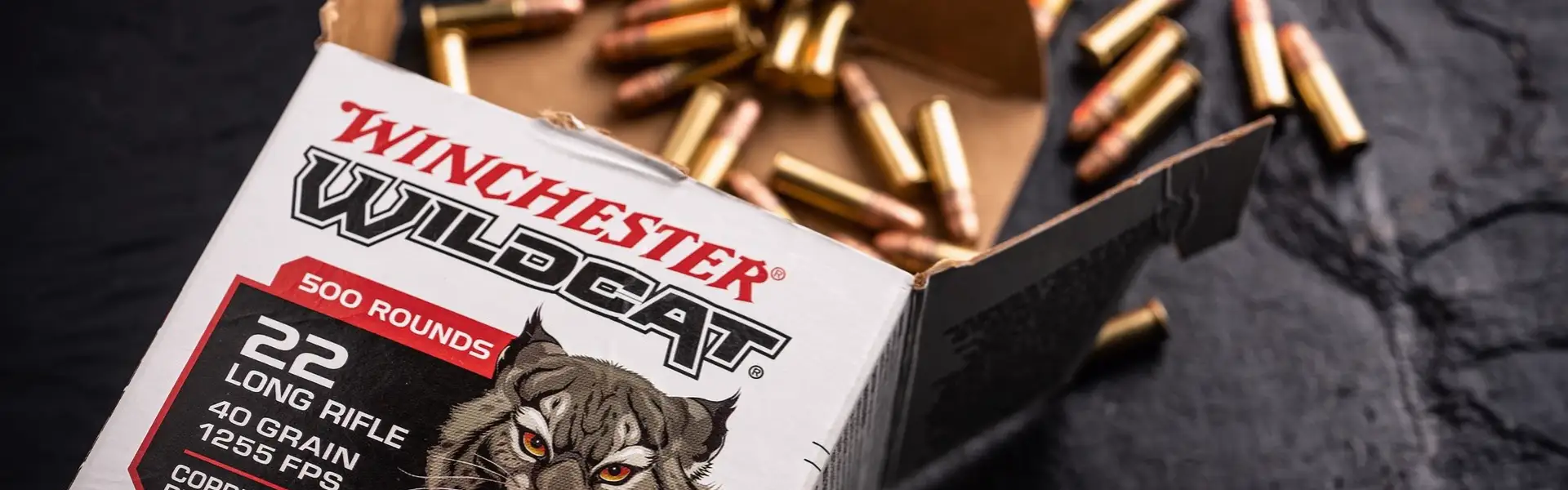
The complete .22-rimfire catalog covering every velocity tier from CCI Quiet-22 (710 fps, BB-gun-quiet for backyard pest control) through standard, high-velocity CCI Mini-Mag, and .22 WMR magnum loads — plus suppressor-friendly subsonic ammunition from Aguila, Browning, and Remington, the SuperNova green tracer for visible-trajectory range fun, .22 Short blanks for training and theatrical use, and CCI .22 WMR No. 12 shotshells for snake and small-pest control. The .22 LR is the most- fired cartridge in the world for good reason — affordable, accurate, and a lifetime's worth of trigger time at pennies per round.
About Rimfire Ammo at Keep Shooting
Keep Shooting's Rimfire Ammo catalog covers the complete velocity range and primary rimfire calibers — .22 LR (Long Rifle, the most-fired cartridge in the world), .22 Short (the original 1857 metallic-cartridge round, still produced for blank and noise applications), .22 Long (a less-common middle cartridge), and .22 WMR (Winchester Magnum Rimfire) magnum loads. Brands include CCI (the Idaho-based American rimfire specialist — the dominant US rimfire ammunition maker), Aguila (the Mexican manufacturer that produces a large share of the world's rimfire output), Winchester, Remington, and Browning.
Rimfire — what it is and where it came from. Rimfire describes a cartridge ignition system in which the priming compound is folded into the rim of the case head rather than contained in a separate primer cup (which is the centerfire design). The firing pin strikes the rim, crushes the priming compound, and ignites the powder charge. The rimfire system is the original metallic- cartridge ignition method — Frenchman Louis-Nicolas Flobert invented it in 1845, and the first commercially-successful rimfire cartridge was the .22 Short, introduced in 1857 for the Smith & Wesson Model 1 revolver. Today rimfire is largely confined to small calibers (the largest common rimfire is the .22 WMR) because the rim must be thin enough to crush reliably under the firing pin — which limits the case strength and therefore the chamber pressure the case can hold. For full-power rifle and pistol cartridges, centerfire is universal; for small-caliber economy and quiet shooting, rimfire still dominates.
The .22 Long Rifle — the world's most-fired cartridge. The .22 LR (Long Rifle), introduced in 1887 by the J. Stevens Arms Company, is by a wide margin the most-produced and most-fired cartridge in the world — estimated annual production exceeds 2.5 billion rounds across all manufacturers globally, a number no centerfire cartridge approaches. The economic case is straightforward: a .22 LR cartridge contains a tiny powder charge (typically 1.0 grain — about 1/40 the powder of a .223 Rem cartridge), a 30 – 40 grain bullet (compared to a 55-grain .223 bullet), and a thin brass case — and the recoil is negligible compared to centerfire calibers. That makes .22 LR the dominant teaching cartridge (Boy Scouts, 4-H, junior NRA programs, and military-marksmanship-units all teach on .22 LR), the dominant small-game-hunting cartridge (squirrels, rabbits, varmints), and the dominant trigger-time cartridge for shooters who want sustained practice without ammunition cost becoming prohibitive. A typical 50-round box of .22 LR retails at $4 – $12 depending on type — somewhere between 8¢ and 24¢ per shot — versus 50¢ – $1.00 per round for typical centerfire ammunition.
CCI — the American rimfire specialist. CCI (Cascade Cartridge Inc., based in Lewiston, Idaho) was founded in 1951 by Richard "Dick" Speer — brother of Vernon Speer who founded the bullet company Speer Bullets just a year earlier. CCI started in priming- compound manufacturing during the Korean War and expanded into rimfire ammunition production through the 1960s and 1970s, eventually becoming the largest American rimfire ammunition manufacturer. Today CCI is part of Vista Outdoor (which also owns Federal Premium, Speer, and other major firearms-industry brands). CCI's specialty has always been rimfire innovation, and our catalog carries seven CCI rimfire offerings: the iconic CCI Mini-Mag .22 LR ($12.49) — the gold-standard plinking-and-small-game round at ~1,235 fps and the most popular single CCI rimfire SKU; the CCI Standard Velocity .22 LR ($6.95) — match- accurate ammunition at 1,070 fps for target shooting; the CCI Blazer .22 LR ($6.95) — the budget high-volume plinking option; CCI Quiet-22 ($7.95) and the Quiet-22 Segmented HP ($10.43) variant — exceptional low-velocity loads (~710 fps) that are quieter than most pellet guns; the CCI .22 Long High-Velocity ($11.63 / 100 rounds) — one of the few production .22 Long offerings still made; the CCI .22 Short Noise Blanks ($22.16 / 100) for training and theatrical use; and the unique CCI .22 WMR No. 12 Shot ($15.84) — a magnum-caliber shotshell for snake control and short-range pest applications.
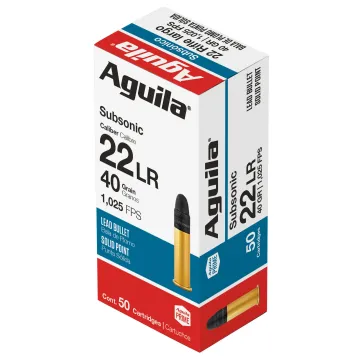
Aguila — Mexican rimfire on a global scale. Aguila Ammunition (Industrias Tecnos S.A. de C.V.) of Cuernavaca, Mexico was founded in 1961 and is one of the largest rimfire-ammunition producers in the world — supplying not just the Mexican domestic market and US imports but ammunition for European and Latin American customers as well. Aguila rimfire is engineered with Eley primers and component partnerships with major American houses (Aguila and Remington have a long-running component partnership). Our Aguila .22 LR High Velocity 40 Grain CPRN ($3.95) is the budget-tier high-volume plinking round — copper-plated round-nose bullets at standard high-velocity speeds, sold at very competitive price points; the Aguila Subsonic .22 LR ($6.32) is the suppressor-friendly sub-1,125-fps load for use with rimfire suppressors.
Subsonic — the suppressor story. Subsonic ammunition is loaded to muzzle velocities below the speed of sound (approximately 1,125 feet per second at standard conditions). Subsonic loads matter primarily for suppressor use: a supersonic bullet produces a sharp ballistic crack regardless of how well the muzzle report is suppressed, but a subsonic bullet produces no ballistic crack at all — and a subsonic .22 LR fired through a rimfire suppressor is one of the quietest practical firearm applications, often quieter than the action's mechanical click. Our subsonic catalog covers the major options: Aguila Subsonic ($6.32), the Browning Pro22 Subsonic .22 LR ($17.32 / 100 rounds — a Browning-branded offering produced under contract by a major rimfire manufacturer), and the Remington Subsonic .22 LR Hollow Point ($35.32 / 225 rounds — bulk-pack from the historic Remington Arms rimfire line). For broader suppressor-friendly selection see our Suppressor-Use Handgun Ammo category.
CCI Quiet-22 — quieter than a pellet gun. The CCI Quiet-22 line deserves special mention because it accomplishes something genuinely unusual: a centerfire-action firearm produces less noise than many spring-piston pellet rifles. Quiet-22 is loaded to roughly 710 feet per second — a hair under sub-pellet-rifle velocity and dramatically below even subsonic loads. The result is a report level that has been measured at 68 decibels at the muzzle (about the level of normal conversation), compared to ~140 dB for a standard unsuppressed .22 LR. The trade-off is energy: at 710 fps a Quiet-22 bullet has only about 55 ft-lbs of muzzle energy and will not reliably cycle a semi-auto action — Quiet-22 is therefore best suited to bolt-action, lever-action, or single-shot rifles. The Quiet-22 load is the right choice for backyard pest control where neighbor noise matters, indoor range use where decibel exposure matters, or teaching new shooters in a low- recoil-and-noise environment. The Quiet-22 Segmented Hollow Point is the same low- velocity load with a CCI segmented bullet that splits into three pieces on impact for additional terminal effect on small game.
.22 WMR — the magnum rimfire. The .22 Winchester Magnum Rimfire (.22 WMR, often called .22 Magnum) was introduced by Winchester in 1959 as a higher-power rimfire option for small-game hunting and varmint use. The .22 WMR cartridge is longer and more powerful than .22 LR — typical loads launch a 40-grain bullet at ~1,910 fps and produce 320 ft-lbs of muzzle energy compared to ~135 ft-lbs for a hot .22 LR. That additional energy makes .22 WMR a practical 100 – 125 yard small-game cartridge (compared to 50 – 75 yards for .22 LR) and a viable coyote and small-predator round at moderate range. Our Winchester X22MHLF .22 WMR ($24.89) is the standard Winchester .22 Magnum offering. The catalog also includes the CCI .22 WMR No. 12 Shot ($15.84) — a magnum shotshell loaded with very fine No. 12 birdshot, designed for snake control, indoor pest control, and short-range bird dispatch where a regular .22 Magnum bullet would over-penetrate. The .22 WMR shotshell is one of the more specialized ammunition products in our catalog and is essential gear for anyone living in copperhead/rattlesnake country.
Tracer ammunition — the SuperNova green. The SuperNova Green Tracer .22 LR ($32.08) is one of the rare commercial-tracer rimfire offerings. Tracer ammunition uses a bullet base loaded with a pyrotechnic compound that ignites on firing and produces a visible glowing trail along the bullet's flight path — green tracers (using barium-based pyrotechnics) are easier to see than red tracers in most lighting conditions. Tracer ammunition is restricted in some jurisdictions (notably California, and on most US public-land BLM and US Forest Service shooting areas due to fire risk), but where legal it provides genuinely spectacular visual feedback for plinking and night-range use. The SuperNova green tracer is one of the few commercial offerings that functions reliably in semi-auto rimfire actions.
The 2008–2014 rimfire shortage. Worth knowing for context: from approximately 2008 through 2014, the United States experienced a sustained .22 LR ammunition shortage driven by a combination of factors — post-2008-election firearm-purchase demand surge, Sandy Hook legislative concerns in 2012-2013, and component shortages affecting rimfire primer chemicals. During the worst of the shortage, .22 LR was either unavailable on retail shelves or selling for 5-10× normal prices. The shortage eventually resolved as manufacturers expanded capacity, and modern .22 LR pricing has returned to historical norms. The residual lesson for serious shooters: maintain a working ammunition stockpile rather than relying on retail availability.
Companion ammunition categories. For the broader ammunition catalog see our Ammunition hub or related Handgun Ammo, Rifle Ammo, and Shotgun Ammo categories. For the .22 LR top-caliber-specific consolidated landing page see our .22 LR top-caliber page.
Keep Shooting ships all rimfire ammunition from our Pennsylvania warehouse with free shipping on orders over $49.95 and hassle-free returns. Whether you are a new shooter learning fundamentals on a Ruger 10/22, a backyard pest-control operator stocking CCI Quiet-22 to keep neighbor relations friendly, a suppressor owner running subsonic Aguila or Remington loads, a small- game hunter equipping a .22 WMR rifle for woods-walking squirrel-and-rabbit work, or a plinker stocking up Mini-Mag and Aguila bulk for an upcoming range weekend — every rimfire round in our catalog is from a respected American or Mexican manufacturer with genuine ammunition-house pedigree, priced to support the sustained trigger time that makes rimfire the foundation of American small-arms shooting.
Frequently Asked Questions — Rimfire Ammo
Keep Shooting carries a wide selection of Rimfire Ammo products from trusted brands. Browse our catalog to see the full range, and use the filters on the left to narrow by brand, price, or product type.
Yes! All orders over $49.95 qualify for free shipping, including Rimfire Ammo products. Orders typically ship within 1–2 business days.
Keep Shooting offers hassle-free returns on Rimfire Ammo products. If you're not completely satisfied, contact our customer service team for a return authorization. All products must be in original, unused condition.
If you need help choosing the right Rimfire Ammo product, our team is available to assist. Check individual product descriptions for detailed specifications, or contact us directly and we'll help you find the best fit for your needs.