
Kershaw Knives
Authorized Dealer • Tualatin, Oregon • KAI USA Since 1974
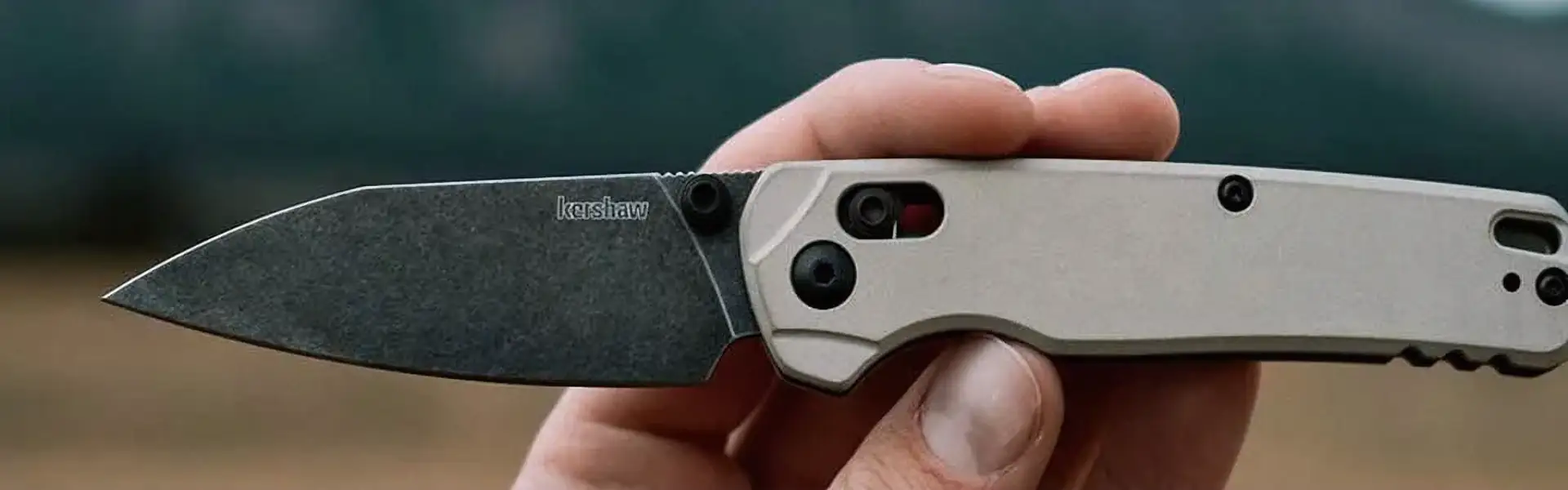
Kershaw Knives was founded in 1974 by Pete Kershaw — a Gerber-trained Oregon knife designer — and is today one of the most innovative American knife brands, manufacturing in Tualatin, Oregon as part of Japan's KAI Group (alongside sister brands Zero Tolerance and Shun). Kershaw introduced the industry-changing SpeedSafe assisted-opening mechanism in 1998 and continues to collaborate with Hall of Fame knifemakers Ken Onion and Ernest Emerson. Keep Shooting carries the Kershaw Lucha balisong, Emerson CQC-8K, Reverb folder, and Secret Agent boot knife.
About Kershaw Knives at Keep Shooting
Keep Shooting is an authorized Kershaw Knives dealer carrying four pieces across the Kershaw catalog: the Kershaw Lucha Butterfly Knife ($150.05) — the premium flipping balisong that re-established American-made butterfly knives in the modern market — the Kershaw Emerson CQC-8K ($57.89) collaboration with custom knifemaker Ernest Emerson, the Kershaw Reverb folding knife ($26.80) as a compact EDC entry, and the Kershaw Secret Agent Boot Knife ($39.56) for deep-carry applications. Kershaw is one of the most innovative American knife brands of the last fifty years — the originator of the SpeedSafe assisted-opening mechanism that defined the modern tactical-folder market — and a leading American- manufacturing presence in the Japanese-owned KAI Group's global cutlery portfolio.
Kershaw was founded in 1974 in Portland, Oregon by Pete Kershaw, a knife salesman who left Gerber Legendary Blades (where he had trained in knife design and manufacturing) to launch his own cutlery company based on designs he had been developing on the side. The company's first production setup was in a converted cement plant in Lake Oswego, Oregon, with early manufacturing contracted to the famous cutlery master Ichiro Hattori in Seki, Japan — the traditional Japanese cutlery capital that has produced Samurai sword-making and high-grade kitchen cutlery for more than 700 years. The Japanese manufacturing partnership gave Kershaw access to a level of blade quality and production volume that would have been impossible to match from a first-year American startup. For the full Gerber catalog — Pete Kershaw's former employer and still one of the most respected American knife brands — see our Gerber brand page.
In 1977, three years after founding, Kershaw became a wholly-owned subsidiary of the KAI Group — the Japanese cutlery conglomerate that also owns Zero Tolerance Knives, Shun premium kitchen cutlery, and Kai Housewares. KAI's ownership kept Kershaw manufacturing in both the US and Japan with strong design continuity and capital investment through the subsequent decades. In 1997, Kershaw opened its first US production facility in Wilsonville, Oregon, giving the company direct control over domestic manufacturing rather than relying solely on contract production in Japan. By 2003, US production had outgrown the Wilsonville facility, and Kershaw moved to a larger site in Tualatin, Oregon, where the company remains today. The Tualatin facility is where current Kershaw USA-made knives are manufactured — blade stamping, heat treatment, handle machining, assembly, and final sharpening all in the same Oregon facility.
Kershaw's defining technical innovation is SpeedSafe — an assisted- opening mechanism introduced in 1998 that uses a torsion bar to complete the blade-deployment arc once the user has opened the blade past a small initial threshold. SpeedSafe is neither a traditional manual folder (pure thumb-push deployment) nor a switchblade (automatic-opening mechanism activated by a single button press); it's the middle ground — a manual-initiated action that finishes itself once the user has started it. This matters legally, because SpeedSafe knives are not classified as switchblades under federal law (the 1958 Federal Switchblade Act only covers truly automatic-opening knives), and they're legal to own and carry in most US jurisdictions that restrict or prohibit switchblades. SpeedSafe also matters ergonomically — it delivers one-handed deployment speed comparable to an automatic-opener while retaining the mechanical robustness and simplicity of a manual folder. Kershaw's SpeedSafe patent changed the tactical-folder market when it was introduced and remains one of the most successful assisted-opening designs in the industry.
The single most important external designer in Kershaw's history is Ken Onion, a Hall of Fame custom knifemaker from Kailua, Hawaii, whose Kershaw collaborations in the early 2000s produced the company's most commercially successful and culturally defining tactical-folder designs. The Leek (2003) is the Ken Onion SpeedSafe flagship — a slim-profile gentleman's folder with a 3-inch Wharncliffe blade that remains one of the best-selling American pocket knives of the 2000s and 2010s. The Blur (2004) is Onion's larger EDC design with a thumb-stud deployment and trac-tec rubber insert grip — a tactical-grade folder that retains the Onion design language. The Chive is the Leek's smaller sibling; Offset and several other Ken Onion signature designs round out the line. Though Keep Shooting doesn't currently carry the full Ken Onion catalog, the Onion-era design DNA is in every Kershaw folder we stock.
The second most significant Kershaw designer collaboration is with Ernest Emerson of Emerson Knives in Harbor City, California — one of the most respected custom tactical knifemakers in America and the designer of the US Navy SEALs' CQC-7 fighting/utility folder that established Emerson's reputation. The Kershaw Emerson CQC-8K ($57.89) in our catalog is the Kershaw- produced collaboration with Emerson — a 3.5-inch Wharncliffe-profile tactical folder featuring Emerson's signature Wave-shaped opening feature on the spine (a small hook that catches on your pocket edge as you draw the knife, deploying the blade one-handed without any thumb-stud or spring-assist mechanism required). The Wave feature is genuinely fast for trained users — faster than SpeedSafe, faster than most automatics — and the CQC-8K brings it to a Kershaw price point well below Ernest Emerson's $300+ custom knives. For the full knives category including Emerson's Wave design context, see our Knives catalog.
The Kershaw Lucha Butterfly Knife ($150.05) is Kershaw's 2018 entry into the balisong market — a premium flipping-community flagship built around a 4.6-inch 14C28N Sandvik stainless blade, channel-construction 6061-T6 anodized aluminum handles, and machined phosphor- bronze pivot bushings. The Lucha is not a tactical or everyday-carry knife; it's a manipulation-focused balisong designed around the modern flipping subculture that developed its own community, conventions, and competition scene through the 2010s. The handle weight distribution is tuned for the rotational balance that advanced flippers want, and the channel- construction design means the handles are milled from a single piece of billet aluminum rather than riveted from multiple pieces — a construction quality that has historically been confined to $400+ custom balisongs. Kershaw's production scale made channel-construction balisong pricing accessible to the intermediate flipping market for the first time. For the full balisong catalog and the history of the Filipino butterfly knife, see our Butterfly Knives category.
The Kershaw Reverb ($26.80) is a budget-entry compact folder — a 2.5-inch blade in a lightweight G10 handle with a carabiner-clip attachment point designed for keychain or gear-loop carry. The Reverb is the kind of folder that makes sense as a secondary or everyday-carry blade for tasks that don't need a full-size tactical folder: opening packages, cutting cordage, and the hundred other small utility tasks that come up every day. The Kershaw Secret Agent Boot Knife ($39.56) is the fixed- blade entry in our Kershaw catalog — a dagger-profile double-edged boot knife in a glass-filled nylon sheath with integrated clip for concealed carry in a boot, waistband, or tactical pack. For the full boot-knife and fighting-knife category see our Specialty Knives catalog.
Kershaw's position in the broader American knife market is worth understanding. The brand sits at the premium end of mass-production — above the big-box commodity pocket knives (Buck's sub-$30 line, Smith & Wesson, Schrade) and below the custom-maker tier (Chris Reeve Knives, Spyderco's premium lines, pure Emerson customs). Most Kershaw folders price between $25 and $200, with the design and build quality of a knife that costs two to three times more from a smaller manufacturer. This pricing tier is only accessible because Kershaw manages its supply chain through KAI Group ownership — the US manufacturing in Tualatin handles the premium and mid-tier SKUs, while specific budget lines continue to be produced at KAI's Seki, Japan facilities or Chinese contract factories with KAI-supervised quality control. Every Kershaw knife in our catalog is covered by Kershaw's Free Lifetime Sharpening program — return the knife to Kershaw's Tualatin service center at any point in the tool's lifetime and they'll sharpen it at no charge.
Sister-brand context: Kershaw shares KAI USA ownership with Zero Tolerance (ZT) Knives — the premium tier of the KAI American portfolio, producing custom-grade tactical folders and fixed blades in the $200-$500 price range — and Shun Cutlery — the premium Japanese-style kitchen knives made in Seki, Japan that compete with Wüsthof and Henckels in the high-end chef's-knife market. Buying a Kershaw is effectively buying into a manufacturing ecosystem with 700 years of Japanese cutlery heritage and 50 years of American design innovation feeding each other across product tiers.
Keep Shooting ships all Kershaw Knives products from our Pennsylvania warehouse with free shipping on orders over $49.95 and hassle-free returns, subject to destination-state legal restrictions for the butterfly-knife SKU (see our Butterfly Knives category for state-specific balisong legality). Whether you're picking up a Lucha for the flipping community, adding an Emerson CQC-8K to a tactical-folder rotation, stocking a Secret Agent boot knife for concealed carry, or buying a Reverb as an everyday utility folder, every Kershaw knife in our catalog is authentic factory inventory from Tualatin, Oregon — backed by Kershaw's lifetime sharpening program and the fifty-year design continuity that has made the brand one of the most respected American pocket-knife manufacturers of the modern era.
Frequently Asked Questions — Kershaw Knives
Yes, we maintain inventory of the most popular Kershaw Knives products. Each product listing shows real-time stock status. If an item is temporarily out of stock, you can sign up for back-in-stock notifications on the product page.
Yes! All orders over $49.95 qualify for free shipping, including Kershaw Knives products. Orders typically ship within 1–2 business days.
Keep Shooting offers hassle-free returns on Kershaw Knives products. If you're not completely satisfied, contact our customer service team for a return authorization. All products must be in original, unused condition.
Yes, Keep Shooting is an authorized Kershaw Knives dealer. All products are sourced directly and include full manufacturer warranty coverage.