
Paracord
550 MIL-SPEC • Atwood Rope • Rothco • Rapid Rope • 20+ Colors
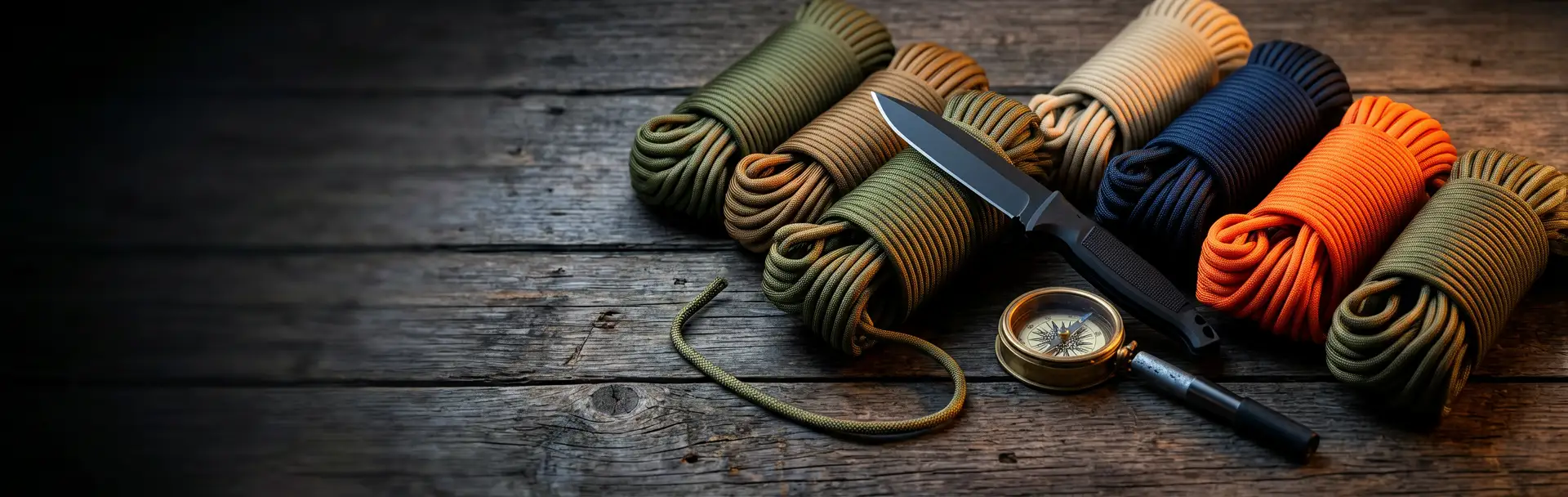
The original WWII airborne-infantry parachute suspension line is now the most universally useful piece of kit in any outdoor, tactical, or survival loadout. Keep Shooting carries 550 paracord (MIL-C-5040 Type III, 550-pound breaking strength, 7-9 inner strands, 100ft hanks) in 15+ colors from Atwood Rope and Rothco — Black, Coyote, OD, Thin Blue Line, Safety Orange, Navy, Hunter Green, Red, Royal Blue, Tan, White, and specialty pink colorways — plus Rapid Rope canister dispensers in Mini ($18.99) and Tall ($24.95) sizes, and paracord bracelet buckle hardware starting at $3.49.
About Paracord at Keep Shooting
Keep Shooting carries a 20-plus-product paracord catalog covering 550-pound MIL-C-5040 Type III cord from Atwood Rope and Rothco in 15+ colors, the Rapid Rope canister-dispensed 1,000-pound utility-rope system in Mini and Tall sizes, and paracord bracelet buckle hardware. Paracord is the most universally useful piece of kit any outdoor, tactical, or survival loadout can carry — a 100-foot hank fits in a jacket pocket, costs less than $10, and handles shelter construction, gear repair, emergency fishing line, bow-drill fire starting, boot-lace replacement, rifle-sling building, and the hundred other field-improvisation applications the cord has absorbed since it came home from WWII as airborne-infantry parachute-line surplus.
Paracord is the common name for Type III parachute cord, a lightweight nylon kernmantle rope originally developed during WWII as the suspension line material for US military parachutes. Airborne infantry and paratroop units used paracord as the load-bearing cord that attached the parachute canopy to the harness — the material had to be strong enough to arrest a jumping soldier's fall, flexible enough to pack tightly into a deployment bag, and resistant to UV, mildew, and rot through long storage in tropical and northern European combat environments. After the war, when millions of surplus parachutes were decommissioned and cut up for material, the suspension cord found its second life as an all-purpose utility rope in the American outdoor and tactical market. By the 1960s paracord was standard inclusion in Army survival kits, Air Force pilot survival packs, and Vietnam-era jungle loadouts. By the 1990s it had entered the civilian tactical and outdoor vocabulary as "550 cord" and become the universal field-repair material for anything that needs to be tied, lashed, bundled, or hung.
The military spec that defines genuine paracord is MIL-C-5040H (the revision most commonly referenced; the spec was inactivated in 1997 and is now maintained as the commercial-industry PIA-C-5040 standard, which is effectively identical). MIL-C-5040H describes six types of parachute cord: Type I (95-pound minimum breaking strength), Type IA (100 lb), Type II (400 lb), Type IIA (225 lb), Type III (550 lb), and Type IV (750 lb). Type III is what the tactical and outdoor market refers to as "550 cord" — the designation comes from the 550-pound minimum tensile breaking strength. The other types exist but are less commonly stocked in civilian catalogs; Type III's combination of strength, weight, and working-diameter (about 4mm / 5/32 inch) makes it the sweet spot for virtually all non-specialist applications.
The construction of Type III paracord is a nylon kernmantle rope — a Swiss/European rope-engineering term meaning "core-and-sheath." The outer sheath is a 32-strand braided nylon mantle that provides abrasion resistance, UV protection, and dimensional stability. Inside the sheath are 7 to 9 inner yarns (MIL-Spec Type III specifies a minimum of 7; commercial production often runs 7-9 depending on manufacturer). Each inner yarn is in turn constructed from 2 or 3 smaller nylon fibers twisted together (MIL-Spec requires 3-ply; commercial grades sometimes run 2-ply). This multi-layer construction is what makes paracord so much more useful than an equivalent-strength single-braid rope: the inner yarns can be pulled out and used independently as sewing thread, fishing line, improvised snare line, dental floss in an austere setting, or tinder fluff for fire starting. Every 100-foot hank of paracord is effectively 100 feet of outer sheath plus 700-900 feet of smaller-gauge inner line.
Field applications for paracord fill a three-volume compendium if you start listing them individually, but the headline categories are: shelter construction (ridge lines, guy lines, tarp tie-outs, bivy attachment), gear repair (boot laces, pack strap replacement, tent pole splint lashing, rifle sling construction, broken- zipper pull substitute), food acquisition (fishing line using inner yarns, snare lines, game-hanging bracing), fire starting (bow-drill cord is traditionally a length of paracord; the frayed inner strands also make excellent tinder), medical improvisation (splint lashing, tourniquet emergency, stretcher/litter construction), and everyday utility (dog leash, keychain lanyard, camera strap, tie-downs for cargo). A 100-foot hank of 550 weighs 7 ounces, takes up less space in a pack than a paperback book, and costs less than a sandwich.
Color selection in paracord is functional as well as aesthetic. Olive Drab, Coyote Brown, Tan, and Black are the tactical and concealment colorways — the correct choice for hunting, reconnaissance, tactical loadouts, and anywhere you don't want the cord to telegraph your position. Safety Orange and Neon Pink are the visibility colorways — if you're running trail-marking lines, setting up a backcountry camp where the ridge line needs to be visible to wandering hikers, or building gear you'll need to find in the dark or in vegetation, high-visibility colors are the right choice. Hunter Green, Midnight Navy, Royal Blue, and Red are the general- purpose colorways that split the difference. Thin Blue Line (black with a blue thread running through the sheath) is the law-enforcement support colorway. Rose Pink, Neon Pink, and White round out the specialty palette for craft-bracelet weaving and paracord jewelry applications.
Our catalog brands reflect three different cordage-market philosophies. Atwood Rope (Beebe, Arkansas) is the longstanding US mil-spec supplier — Atwood manufactures both MIL-C- 5040H certified paracord for government contracts and commercial-grade equivalents for the civilian market. The Atwood colorways in our catalog (Black, Cavalry, Coyote, Molten Orange, Thin Blue Line) are the tactical-market workhorses, priced at $8.95 per 100-foot hank. Rothco is the broader military/tactical supplier whose paracord line ($9.95 per 100ft) emphasizes colorway variety over mil-spec certification — Rothco paracord covers the everyday-tactical and craft-bracelet markets with 10+ colors including Hunter Green, Midnight Navy, Neon Pink, Red, Royal Blue, Safety Orange, Tan, and White. For the full Rothco catalog across tactical apparel, gear, and field accessories, see our Rothco brand page.
Rapid Rope is the innovation entry in our catalog — a small American company (founded 2017 by Chris and Geanie Rodgers, featured on Shark Tank Season 11) that packages a heavier 1,000+ pound flat-braided utility rope inside a patented shatterproof dispenser canister with an integrated cutting blade. It's worth flagging that Rapid Rope is not Type III 550 paracord — the line it dispenses is a higher-strength, flatter-profile utility rope designed for load-bearing applications (vehicle recovery, tie-downs, shelter anchoring, rescue work) where 550 cord's 550-pound rating isn't enough. The canister format solves the two biggest usability problems with traditional cord hanks: the rope is dispensable in exactly the length you need (no measuring-and- cutting with a knife in the field), and the canister prevents tangling or birds- nesting in a pack. The Rapid Rope Mini Canister ($18.99) holds 70 feet of utility rope and is sized for an EDC pocket, range bag, or glovebox; the Rapid Rope Tall Canister ($24.95) holds 120 feet and is sized for a hiking pack, bug-out bag, or vehicle emergency kit. Both canisters are available in Olive Drab, Orange, Tan, and White.
Paracord bracelet buckles (starting at $3.49) are the hardware side of the paracord craft market. A paracord survival bracelet is typically 10-12 feet of 550 cord woven around your wrist with a plastic side-release buckle at the closure; the weave pattern (cobra, king cobra, solomon, fishtail) determines how much cord is stored per inch of finished bracelet. Weaving your own bracelets is a significant discount versus buying pre-made units and lets you pick your own color combinations. The buckle pack in our catalog includes the plastic side-release hardware in sizes that match the standard paracord weave diameters.
Paracord lives in our broader Outdoors category, which also includes our Camping catalog (stoves, mess kits, sleeping bags, water purification), Compasses, and our Survival catalog (signal whistles, emergency kits, purpose-built survival tools). A complete bug-out or backcountry loadout typically includes a 100ft hank of paracord alongside a fixed-blade knife, a compass, a ferrocerium fire starter, a signal whistle, and an emergency shelter or space blanket — the five pieces of gear that, combined, let you handle the hundred-item list of austere-environment improvisations a serious outdoor or tactical user might need to execute.
One closing note on authentic MIL-SPEC vs. commercial paracord: the big-box and craft-market paracord sold as "550 cord" is often a commercial-grade product that looks identical to the MIL-SPEC version but uses thinner inner yarns, a lower-grade nylon formulation, or a lighter sheath construction. For craft bracelets, lanyards, boot laces, and general-purpose tying, this doesn't matter — commercial 550 is fine for 99% of actual field applications. For life-safety applications (climbing backup, rescue, load-bearing structural work) you should buy paracord that's explicitly certified to MIL-C-5040H or PIA-C-5040, and you should understand that paracord is NOT a climbing rope — even genuine MIL-SPEC 550 is rated for 550-pound static load, not for dynamic arresting loads, and real climbing and rescue work requires purpose-built kernmantle dynamic rope with UIAA or CE certification. Paracord is a utility cord, not a life-safety rope.
Keep Shooting ships all paracord products from our Pennsylvania warehouse with free shipping on orders over $49.95 and hassle-free returns. Paracord travels well by mail, doesn't carry any age or hazmat restrictions, and ships to all US states. Whether you're outfitting a bug-out bag or hunting pack, weaving bracelets for your scout troop or EDC, replacing a broken pair of boot laces with something tougher, building a custom rifle sling, or just stocking up on the universally most useful 100 feet of cord in the outdoor market, every paracord product in our catalog is authentic factory inventory from Atwood Rope, Rothco, and Rapid Rope — three of the most respected names in the American paracord market.
Frequently Asked Questions — Paracord
Keep Shooting carries a wide selection of Paracord products from trusted brands. Browse our catalog to see the full range, and use the filters on the left to narrow by brand, price, or product type.
Yes! All orders over $49.95 qualify for free shipping, including Paracord products. Orders typically ship within 1–2 business days.
Keep Shooting offers hassle-free returns on Paracord products. If you're not completely satisfied, contact our customer service team for a return authorization. All products must be in original, unused condition.
If you need help choosing the right Paracord product, our team is available to assist. Check individual product descriptions for detailed specifications, or contact us directly and we'll help you find the best fit for your needs.