

Supernova
Authorized Dealer • Liberty Hill, Texas • Made in the USA
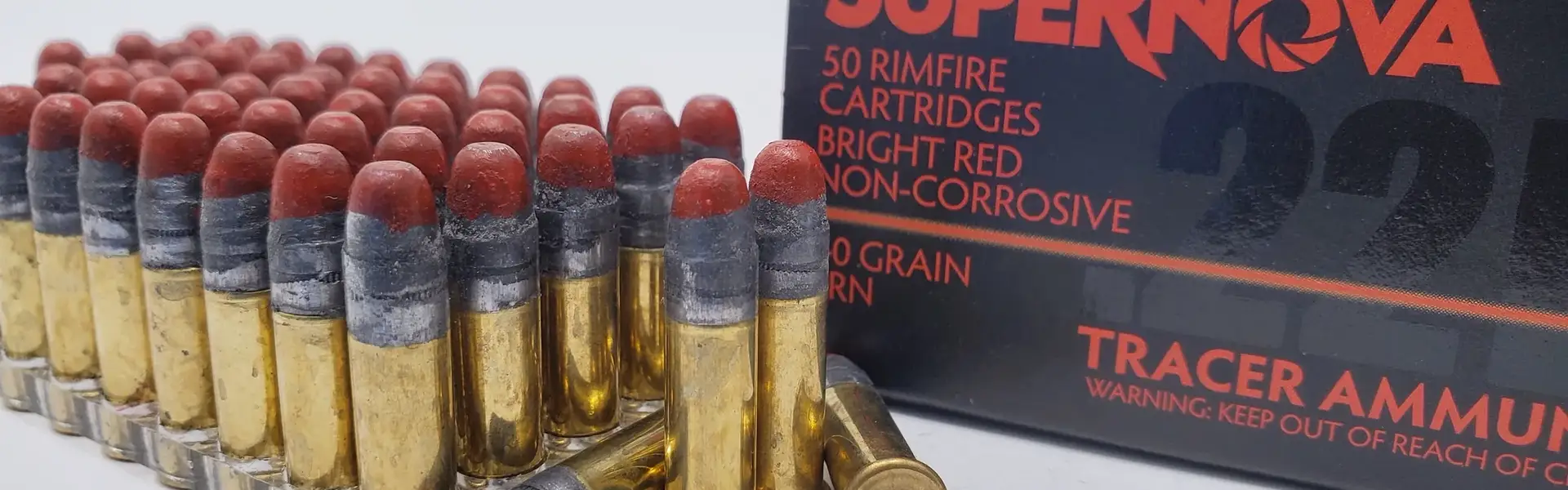
Supernova is the Liberty Hill, Texas manufacturer of pyrotechnic tracer ammunition for handgun and rimfire shooters — a tightly-scoped catalog covering green and red tracer loads in .22 LR, 9mm, and .45 ACP. Each cartridge fires a hollow-based bullet with a pyrotechnic composition similar to a flare; the smokeless powder charge ignites the tracer on firing and the bullet leaves a bright colored beam visible in flight at 100+ yards advertised (user reports stretch to 300+) in both daylight and low light. The line is engineered for range training, trajectory observation, ricochet detection, and the kind of nighttime range shooting where seeing the round’s flight path is the whole point. Keep Shooting stocks 5 Supernova SKUs spanning the catalog: green tracer in all three calibers, red tracer in 9mm and .45 ACP.
Supernova at Keep Shooting
Supernova is the Liberty Hill, Texas manufacturer of pyrotechnic tracer ammunition for handgun and rimfire shooters — a tightly-scoped US-made catalog with a manufacturing and quality association with Piney Mountain Ammunition Co., the long-running North-American civilian tracer producer. Supernova’s line covers two tracer colors (green and red) in three popular handgun and rimfire calibers (.22 LR, 9mm, .45 ACP), all at a nominal muzzle velocity of ~1070 fps and built to be non-corrosive and safe on standard pistol and rifle barrels. The use case is range training, low-light/night shooting, trajectory observation, and ricochet detection — the kind of shooting where actually seeing the bullet’s flight path turns the range session into an instrumented exercise rather than a guessing game. Keep Shooting stocks 5 of the 6 Supernova SKUs: the Green Tracer .22 LR, Green Tracer 9mm, Green Tracer .45 ACP, Red Tracer 9mm, and Red Tracer .45 ACP.
How Tracer Ammunition Actually Works
Tracer ammunition has been a military product category since World War I, originally adopted by British forces in 1915 as the .303 SPG Mark VII tracer for machine-gun pointing. The role expanded dramatically in WWII for aircraft gunnery (every fifth or sixth round in a fighter or bomber belt was a tracer so the gunner could see where the rounds were going at the speeds and ranges involved), and the technology spread to every major military by 1945. Modern US military tracers — the M196 (.223), M62 (7.62 NATO), M276 (5.56 dim trace for NV use) and others — all use the same fundamental pyrotechnic principle Supernova uses in its civilian rounds.
The mechanism is mechanically simple. The bullet is built with a hollow base filled with a pyrotechnic composition chemically similar to a road flare — oxidizers, metal fuels, and color-producing compounds compacted into a small pellet. When the cartridge fires, the burning smokeless powder propellant produces hot gas that not only accelerates the bullet down the barrel but also ignites the tracer composition through the open base. The pyrotechnic burns continuously while the bullet is in flight, producing a bright colored beam of light that the shooter sees as a glowing line tracing the bullet’s path from muzzle to impact.
Green vs Red — The Chemistry Behind the Color
The two color options in the Supernova catalog aren’t cosmetic — the color comes from different chemistry in the pyrotechnic composition, and each color has different visibility and use-case properties.
Green tracers typically use a composition built around barium nitrate as the color-producing oxidizer, which burns at wavelengths around 520–530 nanometers — right at the peak of the human eye’s photopic (daytime) sensitivity curve, which peaks at 555 nm green-yellow. Practical consequence: green tracers are the brightest and most visible to the unaided eye in daylight and at dawn and dusk. Most modern military tracers intended for daylight observation are green or yellow-green for exactly this reason.
Red tracers traditionally use a composition built around strontium nitrate, which burns at wavelengths around 600–640 nm. Red is meaningfully less bright to the eye in daylight than green — but red has two advantages green doesn’t: it’s the canonical signal-flare color in military and civilian use (so it reads unambiguously as “tracer” in mixed environments), and on some night-vision devices the red signature reads differently from green — though modern image-intensifier NV is roughly equally sensitive to both. For range shooters, the practical choice is usually green for daylight visibility, red for aesthetic preference or for distinguishing which gun on the line is shooting which color when running mixed-color drills.
Performance, Visibility, and Why Velocity Matters
Supernova’s nominal muzzle velocity is ~1070 fps across all three calibers. That’s a deliberate engineering choice. Subsonic to mid-subsonic velocity (1070 fps is right at the speed of sound at sea level, ~1126 fps, depending on temperature) gives the tracer composition time to burn across the flight path before the bullet impacts. Higher-velocity loads can outrun the burn rate of the tracer pellet, leaving less visible trail or burning out before reaching the target. Supernova’s velocity envelope is matched to the burn rate of the pyrotechnic charge to maximize visible trace length.
The manufacturer rates trace visibility at 100+ yards, and shooter reports stretch to 300+ yards under good conditions (low ambient light, clear air, dark backdrop). The trace is visible in both daylight and darkness, with the green visibly brighter than red in full sun. For most handgun training distances (7–25 yards defensive, 50 yards range, 100 yards extended-distance handgun work), the trace is bright and obvious throughout the flight path. The rounds are non-corrosive and safe in standard pistol and rifle barrels.
The .22 LR Tracer — The Rimfire Engineering Challenge
Of the three calibers in the Supernova line, the .22 LR tracer is the most engineering-impressive. Rimfire ammunition has tiny case volumes, small bullet weights (typically 30–40 grain), and a non-replaceable primer integrated into the case rim — meaning there’s very little room in the bullet base for a pyrotechnic pellet, and the energy budget for ignition is constrained by the small powder charge. The .22 LR Green Tracer compresses the same fundamental design (hollow-based bullet, pyrotechnic charge, ignited by the powder burn) into a cartridge with roughly a quarter of the volume of a 9mm round. The price premium ($32.08 vs $27.01 for the 9mm) reflects the engineering and yield challenge of fitting reliable tracer chemistry into the rimfire format. Only green is offered in .22 LR — red’s lower brightness margin works less well at the smaller pellet sizes the rimfire format constrains you to.
Use Cases — Where Tracer Ammunition Actually Helps
Tracers are a niche civilian product because the use cases are specific. Where they earn the price premium:
- Low-light range shooting — the original consumer use case. Indoor or dusk-and-dawn ranges where you can see the trace clearly add an entirely new dimension to the session. Particularly valuable for new shooters learning to call their shots.
- Trajectory observation and ballistic training — tracers make the bullet drop curve visible. For shooters learning holdovers at extended handgun distances (50–100 yards), seeing the arc beats reading it off a ballistic table.
- Ricochet observation — on outdoor ranges with steel targets or non-ideal backstops, tracers make ricochets immediately visible. Useful for range-safety awareness and for understanding what a backstop is actually doing with the rounds it absorbs.
- Mixed-color drills — running two shooters simultaneously, one with green tracers and one with red, lets coaches/observers see immediately which round came from which shooter without watching the gun.
- Aesthetic and recreational shooting — honestly, this is a large slice of the civilian tracer market. Night shoots, holiday range sessions, and the fundamental fun of seeing your bullet’s flight path.
Safety, Legality & What You Need to Know Before You Order
Tracer ammunition is real pyrotechnic material in flight, and the safety considerations are non-trivial:
Fire risk is real. Tracer rounds can and will start fires in dry vegetation, wood, or other combustible materials. The manufacturer’s explicit guidance: do not use in dry, windy conditions. Most outdoor ranges with dry grass backstops will not allow tracer ammunition during fire season. Indoor ranges and ranges with sand, dirt, or steel backstops are the appropriate environments.
Jurisdictional restrictions apply. Supernova cannot ship to California, Massachusetts, New York City, or Chicago. Illinois residents require a FOID card. State and local regulations on tracer ammunition vary; if you’re outside the above explicit restrictions, verify your local rules before ordering.
Range rules apply. Many commercial ranges prohibit tracer ammunition by policy regardless of caliber. Confirm with your range before bringing tracer rounds. Most ranges that allow them do so with seasonal restrictions tied to fire risk.
Pairing & Cross-References
Because Supernova’s catalog is ammunition, the natural pairings are the ammunition sub-buckets that group the rounds by caliber and use case. For the complete handgun ammunition catalog covering Supernova’s 9mm and .45 ACP loads alongside the rest of the centerfire handgun inventory (CCI, Federal, Hornady, PMC, PPU, Sellier & Bellot, Winchester, Magtech, Cor-Bon, Fiocchi, and Armscor), see the parent handgun-ammo category. For the rimfire ammunition catalog where the Green Tracer .22 LR sits alongside Aguila, CCI, Federal, and Winchester rimfire, see the rimfire sub-category. For the broader ammunition catalog covering rifle, shotgun, and less-lethal rounds in addition to handgun and rimfire, see the parent ammunition category.
Frequently Asked Questions — SuperNova
Yes, we maintain inventory of the most popular SuperNova products. Each product listing shows real-time stock status. If an item is temporarily out of stock, you can sign up for back-in-stock notifications on the product page.
Yes! All orders over $49.95 qualify for free shipping, including SuperNova products. Orders typically ship within 1–2 business days.
Keep Shooting offers hassle-free returns on SuperNova products. If you're not completely satisfied, contact our customer service team for a return authorization. All products must be in original, unused condition.
Yes, Keep Shooting is an authorized SuperNova dealer. All products are sourced directly and include full manufacturer warranty coverage.